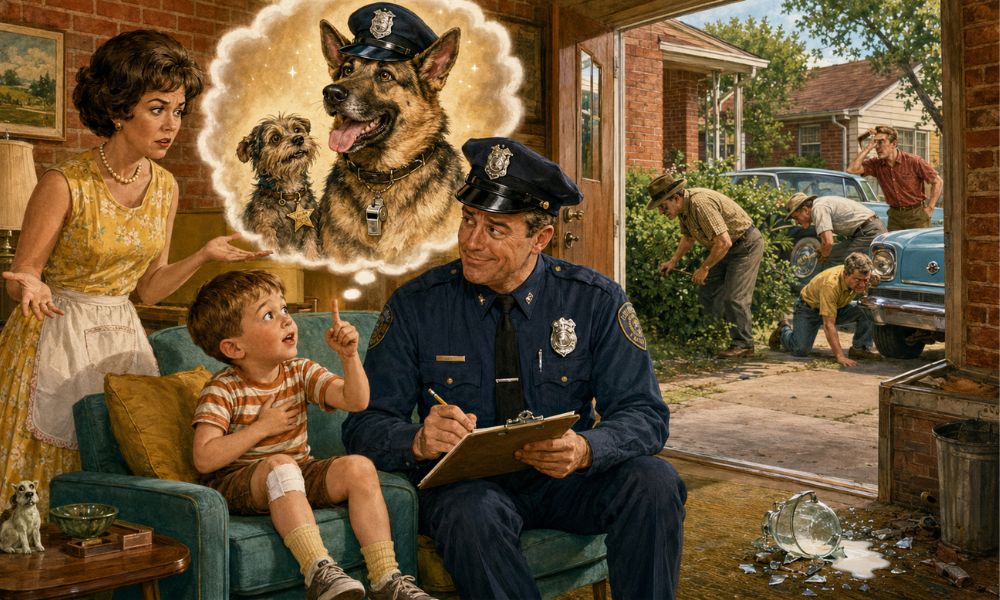
The Police Dog That Never Was
A funny true story recalled by John Fite
The producer of this show, John Fite, recalls a true story—or at least a story that became less true every time five-year-old little Johnny opened his mouth.
The year was 1959, and I had just turned five years old. Back then, a five-year-old could announce, “I’m going outside,” and the parents would simply say, “All right. Try not to get hit by a car, kidnapped, or elected to public office.”
There were no cellphones, no tracking devices, and no neighborhood group texts. Parents just opened the door, released their children into the wild, and hoped most of them returned by supper.
We lived in a small brick house on Fordham Street in Oak Cliff, a section of Dallas. It was a Saturday morning, and I was bored. There were only three television channels, cartoons didn’t run all day, and nobody had invented video games yet. When a child got bored in 1959, he had two choices: use his imagination or do something his father had specifically told him not to do.
I told my dad I was going outside to play.
“Okay,” he said, “but don’t go into the back alley. Somebody dropped a glass jug of milk back there, and there’s broken glass everywhere.”
“Okay,” I said.
Naturally, I headed straight for the alley.
My father had made the mistake of telling me exactly where the danger was. Until then, I had no particular interest in that alley. But now it contained broken glass, forbidden territory, and possibly adventure. To a five-year-old boy, that made it more exciting than Disneyland.
Sure enough, there was glass everywhere. The milk was gone, but the evidence remained. I climbed onto a huge rock—which was probably about eight inches tall but looked like Mount Everest to me—and stood there surveying the scene like a very short explorer.
Then I slipped.
I landed on my knees in the broken glass and got a large cut just below my left knee. Blood started pouring out. I began crying and ran toward the house.
On the way, however, I realized I had a serious problem. My knee was bleeding, but an even more painful injury was waiting inside: my father asking, “What did I just tell you?”
I needed an explanation.
I had about twelve seconds to invent one.
So, using the calm judgment and advanced legal reasoning of a five-year-old, I decided to blame a dog.
I burst into the house and told my mother, “A dog bit me!”
I expected her to clean the cut, give me a cookie, and perhaps say something comforting. Instead, she shouted, “Oh my gosh! Bob, come here! Your son was just bitten by a dog!”
That was the first moment I realized I might have selected the wrong lie.
My dad jumped out of his chair.
“WHAT?”
My father was not a man you wanted involved in an emergency—especially an emergency you had just invented. He was usually grouchy, suspicious, and ready to solve problems through loud questioning.
“Whose dog was it?” he demanded.
Before I could say, “You know what, never mind,” he ran out the front door looking for the dangerous animal.
Meanwhile, my mother sat me down and began wrapping my knee with gauze and enough tape to repair a muffler.
“It’s okay,” I told her. “Let’s just forget the whole thing.”
This was, of course, exactly what every innocent dog-bite victim says.
But it was too late. My father was outside conducting a one-man neighborhood manhunt. He started calling to the neighbors, and soon people from next door and across the street joined the search.
Within minutes, half the block was looking for a dog that did not exist.
People checked behind bushes. They looked under parked cars. One man stood in the street scanning the neighborhood as though the dog might be armed and dangerous.
At that point, I was locked into the lie. I couldn’t admit I had gone into the alley after my father specifically warned me not to. Too many people were involved now. I had witnesses, emergency bandages, and a neighborhood search party. This was no longer a small childhood fib. It had become a community event.
Then my mother did something I had not counted on.
She called the police.
Two squad cars arrived.
Two!
Apparently, Dallas had placed every available officer on the case of The Mysterious Fordham Street Dog.
One squad car began circling the block, searching for loose dogs. The other officer came inside to question the victim—which, unfortunately, was me.
This was when things really started to go south.
Lying to your parents is one thing. Lying to a uniformed police officer holding a clipboard is something else entirely. A clipboard makes any adult look at least fifty percent more official.
I sat on the couch while the officer stood in front of me. He must have been ten feet tall, or at least he looked that way from where I was sitting. He took out his pen and began asking questions.
“Where were you when the dog bit you?”
“In the front yard,” I said quickly. “I was definitely not in the back alley where the broken glass was.”
The officer stopped writing.
“What?”
I had volunteered too much information, but I didn’t understand that concept yet.
“I said I was in the front yard,” I explained. “Nowhere near that glass in the alley.”
He slowly looked over the top of his clipboard. Even at five years old, I recognized that look. It was the same look adults gave you when they knew you were lying but wanted to see how entertaining the lie might become.
“All right,” he said. “Describe the dog.”
This was a question I had not prepared for.
I knew there were big dogs and little dogs. I knew there were mean dogs and friendly dogs. But I did not know many actual breeds. Under pressure, my mind grabbed the first dog description it could find.
“It was a police dog,” I said.
The officer looked down at his uniform, then back at me.
“How do you know it was a police dog?”
Now I was trapped. I needed proof. A good liar would have said it looked like a German shepherd. But I was five, so I gave him the most logical answer available.
“Because he was wearing a policeman’s hat.”
The officer pressed his lips together. His shoulders moved slightly. I could tell he was trying not to laugh.
Fortunately, my father was still outside hunting for Officer Fido and did not hear this part.
My mother did.
“WHAT?” she shouted. “You’re telling us the dog that bit you was wearing a police hat?”
“Yes,” I said firmly.
At that point, changing my story would have made me look dishonest.
Then I added, “And he had a police whistle.”
That seemed like an important detail. A dog in a police hat was suspicious. A dog in a police hat with a whistle was clearly authorized.
The officer asked, “Did he have a badge?”
I couldn’t tell whether he was conducting an investigation or helping me write the story.
“I think so,” I said. “But everything happened pretty fast.”
The officer wrote something on his clipboard. I have always wondered what. Maybe it said, “Suspect is approximately three feet tall, covered in fur, wearing official Dallas Police Department headgear. Approach with treats.”
After a while, both squad cars left. The neighbors returned to their homes, disappointed that they had not captured the hat-wearing criminal. Somehow, no one seemed to be taking my story seriously anymore.
For one wonderful minute, I thought I had gotten away with it.
Then my mother said, “We’re going to the doctor.”
The doctor examined my knee while I repeated my story. By now, I had rehearsed it several times, and like many storytellers, I had begun adding new characters.
I carefully explained that I was not playing in the alley where the broken glass was. Then I told him about the police dog, the police hat, and the whistle.
But I felt the story needed more depth.
So I added that the police dog had a little furry partner.
The smaller dog, I explained, was wearing a sheriff’s badge.
Apparently, this was a joint operation between the city police and the county sheriff.
I didn’t notice at first, but nearly the entire doctor’s office staff had gathered near the examination-room door. Nurses, receptionists, and anyone else who could find an excuse to walk past were listening. They were all trying—and failing—not to laugh.
My mother’s face was getting redder by the minute. She was beginning to suspect that she had summoned two police cars and mobilized the neighborhood because her son had ignored a direct order and fallen on a milk jug.
The doctor studied the wound closely.
“This looks more like a cut than a dog bite,” he said.
I was ready with an explanation.
“He had very sharp teeth.”
The doctor looked at my mother. My mother looked at me. I looked toward the door in case the police dog came back to rescue me.
Then the doctor said, “Still, we can’t risk rabies.”
That was the day I learned a new word.
Rabies.
It was also the day I learned that some lies come with medical consequences.
Out of caution, I had to receive rabies shots in my stomach—one every day for twenty-eight straight days.
Twenty-eight days!
All because I didn’t want to admit that my father was right about the broken glass.
Every day, as I waited for another shot, I had time to think about my decisions. I thought about the alley. I thought about the lie. I thought about the imaginary police dog, his hat, his whistle, and his little deputy friend.
By the end of those twenty-eight days, I had learned three important lessons:
First, listen to your father when he warns you about broken glass.
Second, never invent a dog bite unless you understand the medical follow-up.
And third, if you’re going to tell a lie, don’t give the dog a uniform. That only leads to more questions.
I certainly learned my lesson.
The next time something like that happened, I blamed a cat.