By John Fite | DFW Blogger
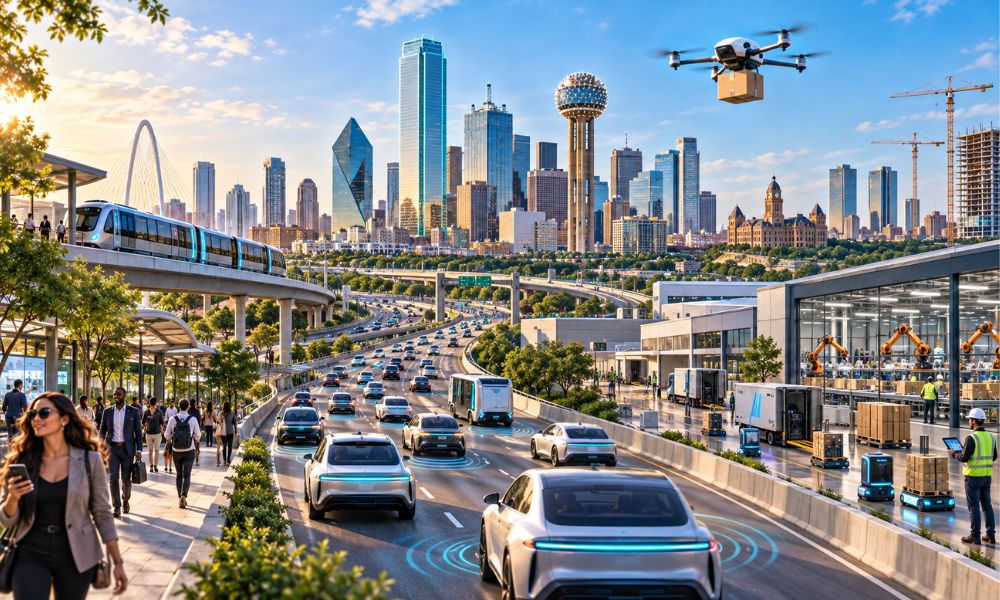
I have lived in the Dallas–Fort Worth area long enough to watch the Metroplex change from a collection of cities and small towns into one of the largest and fastest-moving metropolitan areas in the country. I remember when a telephone was attached to the wall, television had only a handful of channels, and ordering something for delivery usually meant calling a pizza place. Today, I can stand in a Walmart parking lot and see a small aircraft lift a package into the sky. I can pull up beside a car on a Dallas street, look through the window, and discover that nobody is sitting behind the steering wheel.
Those are not scenes from a science-fiction movie. They are happening in North Texas right now.
Walmart and Wing have made Dallas–Fort Worth one of the most important testing grounds for residential drone delivery in America. Waymo opened fully autonomous ride-hailing in Dallas to the general public in August 2026 after serving nearly 150,000 local riders during its earlier rollout. Warehouses around the Metroplex are filling with mobile robots, automated storage systems, artificial-intelligence software and machines that can sort, carry, count, inspect and package products. New factories are rising in Fort Worth, Mesquite, Northlake, Sherman and other communities around North Texas, and many of them look nothing like the factories our parents and grandparents knew.
This raises a question that more people in DFW are beginning to ask: Are we watching the beginning of a better, more productive future—or the beginning of a world in which millions of people are no longer needed at work?
The honest answer is that both possibilities are appearing at the same time. Artificial intelligence and robotics will create businesses, increase production, reduce dangerous work and open entirely new careers. They will also eliminate certain duties, reduce hiring in some occupations and allow companies to produce more with fewer employees. The change probably will not arrive as one dramatic day when everybody loses a job. It will come quietly: one cashier lane, one delivery route, one entry-level office position and one warehouse shift at a time.
The Future Did Not Knock—It Flew Over the Backyard
For most people, artificial intelligence still means a chatbot on a computer screen. We type a question and receive an answer. We ask a program to write an email, create a picture, summarize a document or plan a vacation. That alone is a major change, but it is only the most visible layer of a much bigger transformation.
AI becomes more powerful when it leaves the computer screen and begins controlling physical equipment. A drone combines software, cameras, sensors, navigation, communications and automated decision-making to move an item through real airspace. A driverless car uses cameras, radar, lidar, detailed maps and machine learning to understand streets filled with vehicles, pedestrians, construction zones and unexpected behavior. A warehouse robot must move through a real building without striking a worker, dropping an order or shutting down an operation.
That is why the developments appearing in DFW matter. North Texas is not simply using websites that contain AI. The region is becoming a place where AI interacts with roads, stores, distribution centers, factories, hospitals, airports and homes.
We should not assume that every machine is intelligent in the same way a person is intelligent. Most robots are very good at a narrow set of tasks. A warehouse robot might carry a storage bin flawlessly all day but be unable to pick up a fallen box unless it was designed for that exact problem. A delivery drone can follow an approved route but cannot replace a plumber, comfort a frightened child or negotiate a complicated business agreement. Nevertheless, when thousands of narrow systems are connected across an economy, their combined effect can be enormous.
Walmart Drone Delivery Is Already a DFW Reality
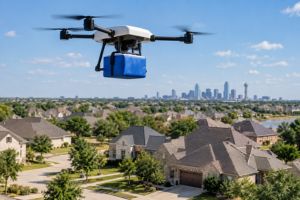 The sight that started me thinking about this subject was Walmart delivering merchandise by drone. It is easy to dismiss a drone carrying a small bag as a novelty, but the larger story is important. In January 2024, Walmart announced that it intended to make drone delivery available to as much as 75 percent of the DFW population through an expanded network involving Wing and Zipline. In June 2025, Walmart and Wing announced another major expansion to 100 additional stores in five other metropolitan areas, building on the system already operating in Dallas–Fort Worth and Northwest Arkansas.
Walmart says eligible customers can receive certain small items in as little as 30 minutes. The Wing aircraft operates within Federal Aviation Administration rules, and Walmart said the service can fly beyond the operator’s visual line of sight within a range of up to six miles from a participating store. The aircraft does not land in the customer’s yard. It hovers above a selected delivery location and lowers the package on a tether.
That may sound like a small convenience, but think about what it replaces. A traditional rush delivery may require a person to accept an order, locate the products, place them in a car, drive through traffic, find the address, deliver the package and drive back into the service area. A drone still requires employees and operational support, particularly to prepare and load orders, maintain equipment, monitor the network and handle unusual situations. But it can remove much of the human driving involved in the last mile.
One drone does not eliminate the delivery business. A network of hundreds or thousands of autonomous aircraft, operating repeatedly from stores across the country, could reshape it.
There are practical limits. These drones carry lightweight orders, weather can interfere, airspace must be managed, and not every home has an appropriate delivery location. They cannot bring a refrigerator or a week’s worth of groceries to the front porch. Yet technology often begins with the easiest and most profitable tasks. The first online stores did not replace shopping malls overnight. The first smartphones did not contain every service we now take for granted. Systems improve, costs decline and customers slowly change their habits.
Here is what drone delivery may mean for DFW:
- 🚁 Faster small deliveries: Medicine, forgotten ingredients, baby supplies and household necessities can arrive without a car making the trip.
- 🚗 Fewer short delivery drives: Some work currently handled by gig drivers could move to autonomous aircraft.
- 🛠️ New technical work: Fleets need maintenance, batteries, inspections, software support, loading systems and trained operators.
- 🏪 Stores become miniature logistics hubs: A neighborhood Walmart is no longer just a building where customers shop; it can serve cars, delivery drivers and aircraft at the same time.
- 🔊 New neighborhood questions: Residents will debate noise, privacy, safety, visual clutter and what happens when many companies want to use the same low-altitude airspace.
Walmart’s DFW experiment is not proof that human delivery drivers will disappear next year. It is proof that a major corporation believes automated delivery can become a normal part of retail. Once a system becomes reliable and economical, businesses rarely ignore the savings.
Source: Walmart’s 2024 DFW drone-delivery announcement and Walmart’s 2025 expansion announcement.
Cars Without Drivers Are Moving Through Dallas
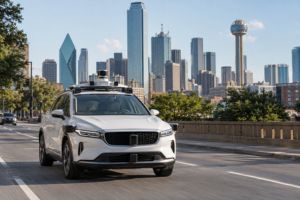 A driverless car creates an even stronger reaction because the empty driver’s seat is impossible to miss. Dallas residents can now hail a fully autonomous Waymo vehicle through the company’s app. Waymo first announced Dallas service in 2025, began welcoming public riders in February 2026 and opened the service to anyone in Dallas on August 4, 2026. The company reported that nearly 150,000 riders had already participated locally by the time it removed the interest-list restriction.
We should be precise about what we are seeing. Many newer personal vehicles offer lane assistance, automatic braking, adaptive cruise control or limited hands-free driving, but those features do not necessarily make them fully autonomous. Waymo’s commercial Dallas service is different: the vehicle can perform the ride without a human driver sitting behind the wheel.
The immediate benefit is easy to understand. A person who cannot drive because of age, vision, disability or another condition may gain greater independence. A visitor can move around without renting a car. A tired passenger can sit back instead of concentrating on traffic. An autonomous vehicle does not become impatient, drive drunk, read a text message or decide that a red light is merely a suggestion.
But the employment question follows the vehicle everywhere it goes. The DFW economy includes taxi drivers, rideshare drivers, chauffeurs, couriers, shuttle drivers, bus drivers and truck drivers. Not all of those jobs involve the same streets or can be automated at the same speed. Moving a passenger through a mapped Dallas service area is different from moving an 80,000-pound truck through ice, construction and remote highways. School transportation, emergency conditions, customer assistance, vehicle security and legal responsibility all complicate the picture.
Still, the direction is clear. A rideshare company’s largest recurring cost is human labor. If an autonomous service can eventually deliver safe, dependable rides at scale, the business pressure to expand it will be powerful.
At the same time, “driverless” does not mean “people-less.” Vehicles must be cleaned, charged, inspected, repaired, recovered and repositioned. Software must be updated. Customers need support. Remote specialists may help resolve situations the vehicle cannot handle. Mapping, fleet facilities, insurance, safety analysis and emergency-response coordination all require human work. The difference is that one support worker may help a fleet rather than personally driving one passenger at a time.
That distinction is at the heart of automation. Technology may not remove every human from an industry. It can drastically change how many people are required to produce the same amount of service.
Source: Waymo’s February 2026 Texas service announcement and Waymo’s August 2026 Dallas opening.
What About All Those New Factories?
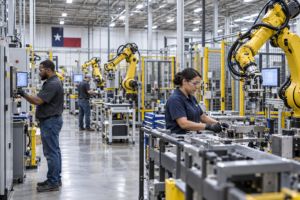 North Texas has attracted a remarkable number of manufacturing, distribution and technology projects. When people see an enormous new building, they naturally imagine thousands of workers filing through the doors. That was often true during the industrial age. Today, the size of a building does not tell us how many people will work inside it.
A modern facility may cover half a million or even a million square feet while using automated conveyors, robotic storage, computer-controlled production, machine vision, sensors and software to move materials. In some cases, a new plant produces far more than an older plant while employing fewer people per unit of output. That does not necessarily mean the building creates no jobs. It means the jobs are different and the relationship between floor space, production and employment has changed.
Siemens in Fort Worth: Automation and Jobs at the Same Time
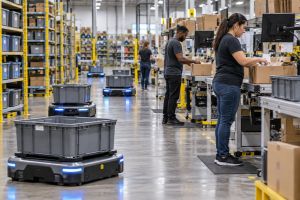 Siemens opened a $190 million, 500,000-square-foot advanced manufacturing hub in Fort Worth in March 2025. The company said the operation had created 480 jobs and planned to reach as many as 800 local jobs by 2026. The plant manufactures electrical equipment used by commercial buildings and industrial operations, including the rapidly growing data-center market.
This is an important counterexample to the idea that a modern factory automatically means fewer people. Siemens describes the facility as advanced and digitally enabled, yet it also brought hundreds of positions to Fort Worth. Automation can make a domestic plant competitive enough to be built here rather than in another country. If the choice is between an automated plant in Texas and no plant in America, automation may create local work.
However, those 800 jobs may support a level of production that once required many more people. The positions may demand stronger electrical, mechanical, computer and quality-control skills than yesterday’s assembly-line work. The benefit is real, but access to that benefit depends on whether local workers receive the training needed to qualify.
Source: Siemens Fort Worth manufacturing overview.
Cardinal Health: A Warehouse Designed Around Robots
Cardinal Health’s Fort Worth distribution center offers an especially clear picture of the new warehouse. The company announced that the facility would use modern robotics and automation for its at-Home Solutions business. Its AutoStore system uses robots to retrieve products from a dense storage grid and bring them to human employees for packing and shipping. The company says the arrangement reduces strenuous walking and lifting, decreases errors and speeds up fulfillment.
That is not a robot shaped like a person walking around and doing everything. It is a complete system in which the building, shelving, containers, software and employee workstations are designed to operate together. Reports describing the Fort Worth installation identified 74 robots, a roughly 1,500-foot automated conveyor and automated equipment that creates custom-size shipping boxes.
There will still be people in the building. They will receive products, pack orders, manage exceptions, maintain machinery and keep the entire operation moving. But the endless miles of walking once associated with warehouse picking can be transferred to machines. That improves safety and productivity while also reducing the number of human hours required for each package.
Source: Cardinal Health’s description of its robotic fulfillment system.
Texas Instruments in Sherman: A Factory Run by Precision
Sherman sits north of the core Metroplex, but the Texas Instruments expansion is close enough and large enough to affect the entire North Texas economy. TI began production at its newest 300-millimeter semiconductor fabrication plant in Sherman in December 2025. The company’s larger plan calls for up to four fabs at the site and as much as $40 billion in investment.
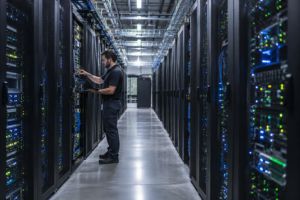 A semiconductor fab is one of the most automated production environments in the world. Tiny contaminants can ruin a product, and many processes require precision beyond human hands. Wafers move through carefully controlled steps using advanced tools, automated material handling and continuous computer monitoring. Yet TI’s broader U.S. expansion is also expected to support thousands of direct jobs and tens of thousands of construction and supporting jobs.
This illustrates the new equation. A highly automated factory can create substantial employment, but the employment is concentrated in engineering, equipment maintenance, process control, facilities, construction, logistics and technical operations. It does not recreate the old factory floor with a worker stationed beside every product.
Source: Texas Instruments’ Sherman production announcement.
MP Materials: North Texas Manufacturing the Parts Robots Need
MP Materials’ Independence facility at AllianceTexas manufactures rare-earth metal and high-performance magnets. These magnets are used in electric vehicles, electronics, defense systems and robotics. In 2026 the company also selected Northlake for a major additional rare-earth magnet manufacturing campus called 10X.
This creates an interesting circle. Artificial intelligence and robotics increase demand for motors and electronic systems. North Texas attracts factories that produce critical parts for those technologies. Those same factories use advanced automation to compete at global scale. Technology is not only replacing certain tasks; it is also creating demand for an entirely new industrial supply chain.
So, Are the New Factories Using Robots Instead of People?
Yes, they are using robotics instead of people for certain tasks—but that is not the whole answer.
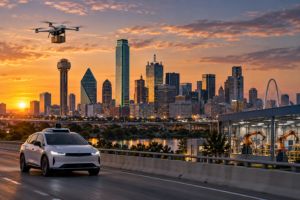 Robots are especially attractive when the work is repetitive, physically exhausting, extremely precise, dangerous or easy to describe through rules. Machines can lift the same object thousands of times, move heavy bins, weld consistent seams, inspect microscopic defects and operate in environments that are too hot, cold, dirty or hazardous for people. They do not need lunch breaks, but they do require electricity, maintenance, software, spare parts and protection from failures.
Humans still perform work that changes frequently, requires judgment, involves delicate physical movement or depends on trust and communication. A technician diagnosing an unfamiliar equipment failure, a supervisor calming an angry customer, a nurse noticing that something is not right and a salesperson understanding an owner’s real concern all use combinations of skills that remain difficult to automate completely.
The key word is tasks. A job is a bundle of tasks. Technology may automate 30 percent of a job without eliminating the occupation. It may allow five employees to do work that once required eight. The company may keep all five, grow faster and eventually hire more people—or it may use the savings to reduce headcount. The final result depends on customer demand, competition, management decisions and how quickly the business expands.
That is why headlines about “jobs created” and “jobs destroyed” can both be true. A new robotic distribution center may hire 200 people, which is good news for those workers and the community. But if a conventional center handling the same volume would have needed 500 people, automation has still reduced the labor required. We usually see the 200 jobs announced at a ribbon cutting. We rarely see the 300 hypothetical jobs that were never posted.
The Quiet Replacement May Begin in the Office
When we think of job-stealing machines, we picture a mechanical arm in a factory. Generative AI may affect the office faster because software can be copied and distributed almost instantly. A physical robot must be manufactured, shipped, installed and maintained. An AI tool can be added to thousands of computers during a weekend.
DFW is filled with corporate headquarters, banks, insurance companies, telecommunications firms, healthcare systems, real-estate businesses, marketing agencies, call centers and professional offices. That makes the Metroplex particularly exposed to changes in white-collar work.
AI can already draft routine correspondence, summarize meetings, classify documents, answer common customer questions, create basic advertisements, compare contracts, prepare reports, translate text, write simple computer code and search company knowledge. None of those abilities guarantees that the system is correct. Human review remains essential, especially in legal, medical, financial and safety-related matters. But the first employment effect may not be a mass layoff. It may be a company deciding that it does not need to fill two vacant entry-level positions because the current team can handle the workload with AI.
The Federal Reserve Bank of Dallas has been tracking this question. In 2024, its survey found that most Texas companies using AI reported little effect on their need for workers at that early stage. By September 2026, however, Dallas Fed researchers examining millions of job postings found early evidence that generative AI was reshaping labor demand. Other Dallas Fed research found that young workers were losing some ground in occupations with greater AI exposure, even though the broader data did not yet show widespread labor-market destruction.
That is the kind of change people may overlook. Companies do not have to fire an entire department for AI to affect employment. They can reduce recruiting, delay replacement hires, combine responsibilities or raise output expectations. Over several years, that can substantially change the number of people working in an occupation.
Office roles likely to feel early pressure include:
- ☎️ Basic customer service and telemarketing: AI voice systems can handle common questions, schedule appointments and qualify leads.
- ⌨️ Data entry and routine clerical work: Software can extract information from forms, invoices and emails automatically.
- 📝 Entry-level content production: Simple product descriptions, social posts and generic articles can be produced quickly.
- 📊 Routine reporting: AI can turn structured data into summaries, charts and first drafts.
- 💻 Basic programming and testing: Developers can generate common code and automate repetitive technical work.
- 📅 Scheduling and administrative coordination: Assistants powered by AI can compare calendars, send reminders and prepare meeting notes.
- 📄 Document review: Insurance, lending, legal and real-estate businesses can use AI to sort and summarize large volumes of paperwork.
Sources: Dallas Fed: Texas firms using AI reported little employment impact in 2024 and Dallas Fed: early automation effects in 2026 job postings.
Warehouses May Change Faster Than Factories
DFW’s location has made it one of the nation’s great distribution hubs. Major interstate highways, rail lines, airports and a huge regional population allow companies to reach millions of customers quickly. Enormous fulfillment buildings have spread through southern Dallas County, Fort Worth, Alliance, Grand Prairie, Irving, Coppell, Wilmer, Lancaster, Mesquite and surrounding communities.
Those buildings are ideal places for automation because much of the work involves predictable movement. Products arrive, receive an identification code, move to storage, return for an order, enter a box and leave on a truck. Every unnecessary step costs time and money. Robots can carry shelves or bins to people, automated conveyors can route packages, cameras can read labels, and software can decide where inventory should be stored.
Amazon openly recruits “robotics warehouse associates” in Dallas who work alongside automated systems. That job title itself tells the story: the worker has not vanished, but the nature of warehouse labor is being reorganized around robotics.
For employees, the result can be positive. Machines can reduce long walks, heavy lifting and repetitive strain. They can keep people away from moving forklifts and hazardous areas. On the other hand, automated systems can set a relentless pace, closely monitor performance and reduce a worker’s control over the day. When the system improves, fewer people may be scheduled for the same order volume.
The most secure warehouse careers will increasingly involve the systems themselves: mechatronics, electrical repair, controls, networking, software, industrial maintenance, safety and operational troubleshooting. A person who understands why the robot stopped will be more valuable than a person whose only task is carrying the bin the robot now carries.
Restaurants, Stores, Hotels and Hospitals Will See More Service Robots
Robotics will not stay behind factory walls. DFW residents already encounter self-checkout lanes, order kiosks, automated telephone attendants, floor-cleaning machines and small robots that carry food through restaurants. Hotels can use robots for room-service delivery. Hospitals can move linens, medications and supplies through hallways. Security equipment can patrol a property while sending video to a central operator.
These systems are still imperfect. A restaurant is full of spilled drinks, moving children, rearranged chairs and customers who ask unexpected questions. A robot may deliver plates to the table, but a server still explains the menu, notices a problem and creates the experience. A cleaning robot may handle open floor space while a person cleans corners, restrooms and complicated areas.
Once again, partial automation matters. If a robot performs enough routine travel, one employee may cover a larger area. If a kiosk takes routine orders, workers can concentrate on preparation and service—or management can schedule fewer cashiers. Businesses will describe this as helping employees, improving service and solving labor shortages. Sometimes that will be true. It can also reduce the bargaining power of workers whose tasks are easiest to automate.
AI Is Creating a Second Construction Boom: Data Centers
Artificial intelligence does not float invisibly in the air. Every response from an AI system is produced by physical computers inside data centers. Those buildings require land, servers, cooling equipment, fiber connections, backup systems and enormous amounts of electricity. DFW has become one of America’s major data-center markets because it offers available land, strong telecommunications connections, business-friendly policies and access to the Texas electric grid.
This creates jobs for construction workers, electricians, engineers, equipment suppliers, security personnel and specialized technicians. Siemens has specifically connected demand for its Fort Worth electrical products to data centers and other high-growth industries. Federal employment projections released in August 2026 anticipate that the computing-infrastructure, data-processing and web-hosting industry will grow rapidly as AI adoption accelerates.
But data centers also demonstrate why investment dollars and permanent jobs are not the same measurement. A data-center campus can cost billions of dollars during construction and contain extraordinary amounts of equipment, yet require a relatively modest operations staff once it is running. The economic benefits may be substantial, but communities should ask how many permanent local jobs will exist, what tax incentives were granted and who will pay for new power-generation and transmission infrastructure.
Electricity may become one of the biggest local AI issues. The Dallas Fed has warned that AI-driven data centers are reversing years of relatively flat power demand. More demand can encourage investment in generation, storage and grid improvements, but it can also create pressure on prices and reliability if infrastructure does not keep pace. In a Texas summer, electricity is not an abstract concern.
Jobs Most Likely to Change First in DFW
No list can predict an individual worker’s future. Technology adoption can be slower than expected, laws can change, and customers may continue preferring human service. Occupations also contain many different duties. A plumber and a telemarketer may both use a telephone, but that does not make their jobs equally vulnerable to a voice bot.
A useful way to think about risk is to ask four questions: Is the work repetitive? Is it performed mostly on a computer? Can success be measured easily? Does the task take place in a controlled environment? The more often the answer is yes, the easier it is to automate at least part of the job.
In DFW, the first large effects are likely to appear in these areas:
- 🚕 Driving and delivery: Robotaxis and drones are already operating, although trucking and specialized transportation will take longer.
- 📦 Warehousing: Robots can retrieve, carry, sort and route products in controlled buildings.
- 🛒 Retail checkout: Self-checkout, computer vision and app-based purchasing reduce cashier duties.
- 🎧 Call centers: DFW has a large corporate service sector, and AI voice systems can answer many routine contacts.
- 🗂️ Administrative support: Scheduling, form processing, meeting notes and routine communication are increasingly automated.
- ✍️ Basic marketing production: AI creates first drafts of ads, emails, images and videos at very low cost.
- 🏭 Repetitive production: Robotic arms and computer-controlled equipment excel at consistent, precisely defined movements.
- 🔍 Routine inspection: Machine-vision systems can examine products continuously and detect certain defects faster than people.
Jobs that require physical flexibility, personal trust, responsibility, creativity, persuasion or care will be more resistant to complete replacement. Electricians, HVAC technicians, plumbers, nurses, therapists, teachers of young children, emergency responders, equipment technicians, skilled performers and relationship-driven salespeople all work in environments where the unexpected is normal.
Even those workers will use AI. A plumber may use software to diagnose symptoms, prepare an estimate and schedule a route. A nurse may receive an automated summary of a patient’s record. A magician or podcaster may use AI to create an advertisement or edit audio. The person remains central, but the surrounding work changes.
Will AI Eliminate More Jobs Than It Creates?
Nobody can answer that question with certainty, especially at the local level. Confident predictions often depend on assumptions about how quickly the technology improves, how much it costs, whether customers accept it and how businesses use the savings.
History gives us reasons for both optimism and concern. Farm machinery eliminated an enormous amount of agricultural labor, yet the economy created industries and occupations that earlier generations could not imagine. Automobiles eliminated much of the work surrounding horses while creating factories, dealerships, repair shops, highways, motels, suburbs and entire oil industries. Personal computers removed many typing and filing duties while producing millions of technology-related jobs.
However, history does not guarantee that every worker benefits or that the transition is painless. A new occupation in another city does not help someone who loses a job tomorrow and cannot afford months of training. A better national economy can still leave a particular neighborhood behind. New technology may increase total wealth while directing most of the gains to the owners of platforms, data and machines.
The U.S. Bureau of Labor Statistics projects that total national employment will grow by about 5.9 million jobs from 2025 to 2035. Healthcare and social assistance are expected to drive much of that growth. AI is expected to increase demand for data scientists, information-security analysts, software developers and computing-infrastructure workers. At the same time, automation is expected to limit or reduce employment in several routine office and administrative occupations.
Those projections are reassuring in one respect: the official outlook is not for work to disappear. But the mix of work will change. The new jobs may require different skills, exist in different locations or pay differently from those that decline. The real challenge is not merely whether America has a positive job count in 2035. It is whether a 45-year-old DFW employee whose position is automated can move into the new economy without losing a decade of income and stability.
Source: U.S. Bureau of Labor Statistics 2025–2035 employment projections.
The People at Greatest Risk May Be the Ones Trying to Get Started
Entry-level jobs deserve special attention. Businesses have traditionally hired beginners to perform simpler assignments while they learned. A junior employee might organize information, prepare a basic draft, answer common questions or write uncomplicated computer code. Those are exactly the duties generative AI handles first.
If companies automate the bottom rung of a career ladder, how does a young person gain the experience needed to reach the second rung? Employers may want experienced workers while offering fewer opportunities to become experienced. Dallas Fed research published in 2026 found signs that young workers were losing ground in occupations with high exposure to AI. The evidence did not show a universal collapse, but it identified a warning worth taking seriously.
This matters in DFW because the region continues to attract young adults and families. Local colleges and high schools cannot train students only for the way an occupation worked five years ago. Students should learn the underlying profession and how to use AI effectively, verify its output and recognize its failures.
The best beginning worker may no longer be the person who can produce a routine first draft. It may be the person who can direct an AI system, check the facts, improve the result, speak with the customer and take responsibility for the final work.
What DFW Schools and Colleges Need to Teach
North Texas has a strong network of universities, community colleges, trade schools and public-school career programs. They will become even more important as factories and warehouses require fewer purely manual roles and more technicians who understand both machines and software.
Training does not mean everyone must become a computer scientist. The Metroplex needs people who can install an industrial sensor, repair an automated conveyor, diagnose a motor, secure a computer network, operate precision equipment and manage safety around autonomous machines. These roles combine hands-on ability with digital understanding.
Useful areas of preparation include:
- 🔧 Mechatronics and industrial maintenance—the combination of mechanical, electrical and computer-controlled systems.
- ⚡ Electrical and power-system work—especially as data centers, factories and electric vehicles increase demand.
- 🤖 Robotics operation and repair—including sensors, motors, controls and safety procedures.
- 🛡️ Cybersecurity—because a connected factory or autonomous fleet creates new ways for systems to be attacked.
- 📈 Data and AI literacy—knowing how to use automated tools, question their output and protect sensitive information.
- 🗣️ Communication and customer judgment—human skills become more valuable when software handles routine production.
- 🧰 Skilled trades—real buildings and machines still require installation, inspection, repair and emergency service.
Employers also have a responsibility. It is unreasonable to eliminate a routine position, advertise a technical replacement job and then complain that no trained workers exist. Apprenticeships, paid training and partnerships with local colleges can help existing employees move upward instead of being shown the door.
Small DFW Businesses Can Gain Power From AI
The AI story is not limited to Walmart, Waymo and giant factories. A one-person business can now use tools that once required an office staff or advertising agency. That may be one of the most positive effects for a region with so many contractors, entertainers, consultants, real-estate professionals and home-service companies.
A local owner can use AI to draft an estimate, organize a customer list, create social-media ideas, answer frequently asked questions, improve a website, translate a message, plan a delivery route or prepare a video script. Used carefully, these tools save time that the owner can spend serving customers and making sales.
I have seen this personally as a blogger, marketer, podcaster and entertainer. AI does not walk into a daycare and perform a magic show. It does not build decades of trust with a customer. But it can help prepare the advertisement, clean up the writing, produce a voice track, organize research or turn one long story into several short promotional pieces.
That creates an opportunity for DFW entrepreneurs:
- 💡 Use AI to compete with larger companies without pretending the technology is always correct.
- 🤝 Keep the personal relationship that large automated companies struggle to provide.
- 📣 Produce consistent marketing while making sure the final message still sounds human.
- 🧾 Automate paperwork and follow-up so more time is available for paying customers.
- ⭐ Sell trust, local knowledge, reliability and personality—qualities that cannot be copied with one prompt.
Small businesses should also be careful. Uploading customer records, confidential contracts or private health and financial information into an unapproved AI service can create serious risks. Owners must understand what a tool stores, how it uses data and whether a human has verified important output. AI can confidently provide a wrong answer, invent a source or create an image that misrepresents reality.
The Benefits Are Real—and So Are the Costs
It is easy for this debate to become emotional. One side describes a world of abundance, safer roads and freedom from unpleasant work. The other sees unemployment, surveillance and machines controlled by a small number of powerful corporations. DFW will probably experience pieces of both.
Possible Benefits
- ✅ Safer dangerous work: Machines can enter hazardous areas, lift heavy objects and perform repetitive tasks that injure people.
- ✅ Greater independence: Autonomous transportation may help people who cannot drive.
- ✅ Faster service: Drones, routing software and automated fulfillment can reduce delivery times.
- ✅ More domestic production: Automation can make a North Texas plant competitive with overseas manufacturing.
- ✅ Higher productivity: Businesses can create more goods and services with the same resources.
- ✅ New careers: Robotics, maintenance, cybersecurity, data science, power systems and AI oversight will grow.
Possible Costs
- ⚠️ Fewer routine jobs: Driving, clerical, checkout, call-center and warehouse tasks face real pressure.
- ⚠️ A harder start for young workers: AI may perform the basic work once used to train beginners.
- ⚠️ Greater inequality: Owners of valuable technology may capture more of the productivity gains than workers.
- ⚠️ Privacy and surveillance: Autonomous systems use cameras, location information and large amounts of data.
- ⚠️ Cybersecurity risks: Connected vehicles, warehouses and factories can fail or be attacked.
- ⚠️ Pressure on electricity and infrastructure: AI data centers require large, dependable power supplies.
- ⚠️ Loss of human contact: A cheap automated interaction is not always a better interaction.
What Local Leaders Should Be Asking
DFW cities compete aggressively for factories, distribution centers and technology campuses. Officials announce the investment total and promised jobs, and the ribbon-cutting photographs appear in the news. Those numbers matter, but they are not enough for the AI age.
Before granting tax incentives or approving major infrastructure, local leaders should ask:
- 🏗️ How many construction jobs and how many permanent jobs will the project create?
- 💵 What will the permanent positions pay, and how many will be available to people without a four-year degree?
- 🎓 Will the company fund training, apprenticeships or partnerships with local schools?
- ⚡ How much electricity and water will the facility use, and who pays for the necessary infrastructure?
- 🤖 Which parts of the operation are automated, and could promised employment fall as the technology improves?
- 📍 Are the jobs accessible by public transportation, or will workers need a car and a long commute?
- 🔐 What safeguards protect residents’ privacy, safety and data?
- 📉 What happens if the company closes, downsizes or fails to meet its job commitments?
That is not anti-technology. It is responsible economic development. A city should welcome innovation while making sure residents receive lasting value in return.
What DFW Workers Can Do Right Now
No one should panic because a robot appeared in a parking lot. At the same time, waiting until a job disappears is not a strategy. Workers can begin strengthening the parts of their careers that technology complements rather than easily replaces.
- 🧠 Learn the AI tools used in your field. You do not have to love them, but you should understand what they can and cannot do.
- 🔎 Become the person who checks the machine. Verification, troubleshooting, quality control and accountability remain valuable.
- 🛠️ Add a physical or technical skill. Equipment repair, electrical work, controls and field service connect digital knowledge to the real world.
- ❤️ Strengthen human skills. Trust, leadership, sales, empathy, negotiation and performance are difficult to automate.
- 📚 Use short, targeted training. A certificate or apprenticeship may be more practical than starting an entirely new degree.
- 🌐 Build a professional reputation. Relationships, referrals and proof of dependable work provide protection when generic output becomes cheap.
- 💼 Keep examples of your results. Show how you saved money, solved problems, retained customers or improved safety—not merely which duties you performed.
The goal is not to compete with a machine at the exact task the machine does best. It is to use the machine while contributing judgment, responsibility and real-world ability around it.
What Happens Over the Next Five Years?
By the early 2030s, drone delivery will probably be more common across suburban DFW, although it will remain better suited to smaller urgent purchases than full grocery orders. Autonomous ride-hailing will likely expand its service territory and fleet if the technology continues to perform safely and the economics work. We may see autonomous shuttles in controlled locations such as airports, business campuses and entertainment districts before driverless vehicles replace every kind of professional driver.
Warehouses will continue adding robots because their environments are controlled and the financial return can be measured in seconds, steps and packages. Factories will use more machine vision, predictive maintenance and automated material handling. Restaurants and hotels will experiment with service robots, but customer preference and the disorder of public spaces will slow complete automation.
Generative AI will spread fastest because it is software. The biggest short-term employment effect may be less visible than a robotaxi: smaller office teams, fewer beginner assignments and higher expectations for each employee. Companies may stop describing AI as a special project and simply build it into email, accounting, customer service, design and scheduling systems.
We will also see new failures. A drone will drop something where it should not. An autonomous car will block traffic. An AI customer-service agent will trap someone in a maddening loop. A company will trust incorrect information. Criminals will use cloned voices and realistic images for fraud. Every major technology develops through a mixture of genuine progress, exaggerated promises, mistakes and regulation.
The winners will not necessarily be the cities that install the most robots. They will be the cities that combine innovation with reliable infrastructure, good schools, practical training and opportunities for ordinary residents.
This Is Just the Start
The drone over a Walmart and the empty driver’s seat in a Dallas car are symbols of something much larger. Artificial intelligence is gaining eyes through cameras, ears through microphones, hands through robots and mobility through vehicles. It is moving from the digital world into the physical Metroplex.
I do believe more people will be replaced in certain jobs. Companies have always adopted technology that lowers costs, and AI can now perform tasks we once thought required a person. It would be foolish to pretend otherwise. But it would also be wrong to look at every new factory and assume no human opportunity remains. Siemens opened an advanced Fort Worth plant while creating hundreds of jobs. TI’s automated fabs require skilled workers. Robotic warehouses need technicians and operators. The AI boom is building data centers, electrical systems and new supply chains across North Texas.
The real question is not whether DFW can stop automation. It cannot, and trying to freeze technology would send investment somewhere else. The question is whether the people who live here will own businesses, learn the new skills and share in the productivity—or simply watch the machines pass overhead while the benefits flow elsewhere.
North Texas has reinvented itself before. It grew from cotton, cattle and railroads into a center for aviation, telecommunications, finance, healthcare, logistics and technology. The next reinvention is already underway. This time, it may move faster than anything we have experienced.
When you see a drone carrying groceries across a DFW neighborhood or a car moving through Dallas without a driver, take a good look. You are not watching a demonstration of the distant future.
You are watching the opening scene.
Editor’s note: Technology and service areas change quickly. This article was researched and updated on September 15, 2026. DFW Blogger has linked to company announcements and government research so readers can review the underlying information.
Sources and Further Reading
- Walmart: DFW drone-delivery expansion
- Walmart and Wing: expansion to additional cities
- Waymo: autonomous rides begin in Dallas and other cities
- Waymo: Dallas service opens to everyone
- Siemens: Fort Worth advanced manufacturing hub
- Cardinal Health: robotic fulfillment system
- Texas Instruments: Sherman fab begins production
- Federal Reserve Bank of Dallas: early AI automation signals in job postings
- Federal Reserve Bank of Dallas: young workers in AI-exposed occupations
- U.S. Bureau of Labor Statistics: 2025–2035 employment projections