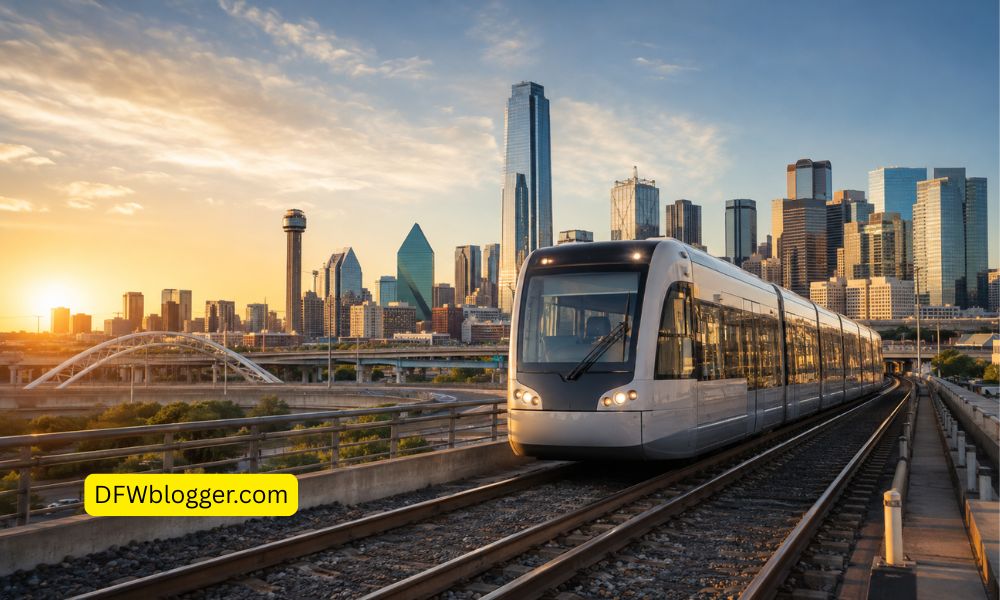
From streetcars and interurbans to DART light rail, TEXRail, the A-train and the Trinity Railway Express, North Texas has built an impressive—but still incomplete—public transportation network.
When most people think about transportation in Dallas-Fort Worth, they picture highways: Interstate 35, Interstate 30, Central Expressway, LBJ Freeway, the George Bush Turnpike and a seemingly endless collection of toll roads and construction zones. The automobile has shaped modern North Texas more than almost anything else. However, trains and public transit have also played an important role in the region’s history, and they are becoming increasingly important as the Metroplex continues to grow.
Today, the DFW area is served by several separate transit organizations. Dallas Area Rapid Transit, better known as DART, operates the largest system. Trinity Metro serves Fort Worth and parts of Tarrant County. The Denton County Transportation Authority operates the A-train and other services in Denton County. DART and Trinity Metro jointly operate the Trinity Railway Express between Dallas and Fort Worth. Arlington has developed its own on-demand transit network, while smaller agencies serve portions of the outer counties.
The result is not one single DFW transit system. It is a patchwork of systems, routes, funding arrangements and service areas. Some parts work remarkably well. Other parts remain difficult to use without a car. To understand where public transportation in North Texas stands today, it helps to begin more than a century ago.
Before the Freeways: Streetcars and Interurban Railways
Dallas and Fort Worth both had streetcars long before either city became dominated by automobiles. Electric streetcars carried residents between downtown districts, neighborhoods, businesses and entertainment areas. In the early 1900s, privately operated interurban railways also connected communities throughout North Texas.
One of the best-known lines connected Dallas and Fort Worth. Other electric interurban routes reached places such as Denison, Sherman, Corsicana, Waco and smaller towns between the major cities. For people living in that era, electric rail was not a novelty. It was a practical way to travel to work, shop or visit another community.
The surviving Monroe Shops building in Dallas is a reminder of that period. Constructed in 1914 to maintain cars used by the Texas Traction Company and Southern Traction Company, it was later restored by DART and became the headquarters of the DART Police Department.
Streetcars and interurban trains began losing passengers as automobiles became more affordable and roads improved. Following World War II, North Texas expanded outward. New subdivisions, shopping centers and employment districts were designed around cars rather than rail stations. Dallas ended regular streetcar service in 1956, and buses replaced many rail routes. Fort Worth’s old streetcar system had also disappeared. By the time the great freeway-building era arrived, the region had made a decisive turn toward the automobile.
The Creation of DART
Dallas operated the Dallas Transit System from 1964 until 1983, but regional growth made it clear that transportation problems did not stop at the Dallas city limits. Dallas Area Rapid Transit was created on August 13, 1983, replacing the city-operated system and establishing a regional transit authority funded primarily by a one-cent sales tax collected in its member cities.
DART’s creation did not immediately produce a large rail network. The agency inherited buses and spent years planning, acquiring property, developing routes and building public support. There were political battles, financial concerns and arguments over which cities would receive rail service first. Some communities joined DART; others chose not to participate because membership required dedicating sales-tax revenue to the agency.
The first 20 miles of DART light rail opened in June 1996. For North Texas residents accustomed to buses and highways, the new electric trains represented a dramatic change. The original system included portions of what became the Red and Blue lines, linking downtown Dallas with areas to the north and south.
Expansion continued over the following decades. The Red Line reached Richardson and Plano. The Blue Line extended toward Garland and Rowlett. The Green Line connected southeast Dallas, Fair Park, downtown, northwest Dallas, Farmers Branch and Carrollton. The Orange Line added service through Irving and Las Colinas to Dallas Fort Worth International Airport.
DART now reports a 93-mile light-rail network with 66 stations, making it one of the nation’s most extensive light-rail systems by route mileage. Its trains serve Dallas and several surrounding member cities, while the broader DART operation includes hundreds of buses, nearly 7,000 bus stops, paratransit and GoLink on-demand zones.
In fiscal year 2025, DART reported 22.1 million light-rail passenger trips and 28.6 million bus trips. Those numbers demonstrate that rail receives much of the public attention, but buses still carry more riders and remain essential to the system.
The Trinity Railway Express: Connecting Dallas and Fort Worth
The Trinity Railway Express, commonly called the TRE, was the first modern commuter-rail line in the region. DART opened the original 10-mile segment on December 30, 1996, connecting Union Station in downtown Dallas with Medical/Market Center and South Irving. More than 4,000 passengers rode on its first day.
The route expanded into Tarrant County in 2000 and reached downtown Fort Worth in December 2001, completing the basic Dallas-to-Fort Worth corridor. Today the TRE is jointly owned and operated by DART and Trinity Metro. Its approximately 34-mile route includes ten stations and serves downtown Dallas, the medical district, Irving, CentrePort, Richland Hills and downtown Fort Worth.
The TRE is one of the most useful examples of regional cooperation in North Texas. A passenger can travel between the two major downtowns without fighting Interstate 30 traffic. At CentrePort, riders can connect to services serving Arlington and the airport area. At Fort Worth Central Station, they can transfer to Trinity Metro buses and TEXRail. At Union Station, they can reach DART light rail and the Dallas Streetcar.
However, the TRE is still primarily a commuter-oriented service. It does not provide the same frequency or late-night coverage that passengers would expect from a true high-frequency regional metro. Sunday service is generally absent, except for certain special events, and that limits its usefulness for weekend workers, tourists and people attending entertainment events.
Fort Worth Transit Becomes Trinity Metro
The Fort Worth Transportation Authority began operating in November 1983. For many years, local residents simply called it “The T.” In 2018, the agency adopted the Trinity Metro name to present a more modern regional identity.
Trinity Metro operates Fort Worth-area bus routes, ACCESS paratransit, vanpools and ZIPZONE on-demand service. It also shares responsibility for the TRE and owns TEXRail. Its core service area is much smaller than the full spread of Tarrant County, although contract services and rail stations extend its reach into cities including Grapevine and North Richland Hills.
The largest recent addition is TEXRail, which opened in January 2019. TEXRail runs from Fort Worth T&P Station and Fort Worth Central Station northeast through North Richland Hills and Grapevine to Terminal B at DFW Airport. Unlike DART’s electric light-rail vehicles, TEXRail uses diesel multiple-unit trains designed for regional service. The trains offer comfortable seating, luggage space and a ride that feels more like commuter or regional rail.
TEXRail has become one of North Texas transit’s strongest recent success stories. It gives Fort Worth and northeast Tarrant County a direct rail connection to DFW Airport, downtown employment, hotels, Grapevine attractions and major events. Trinity Metro reported continued ridership growth during 2025, with TEXRail finishing the year nearly 12 percent above the previous year. Agency reports also showed on-time performance above 98 percent during parts of 2025.
Plans have advanced for a TEXRail extension into Fort Worth’s Medical District. Such an extension could make the line more useful for employees, patients and residents and create a stronger rail spine through central Fort Worth. As with nearly every major transit project, its ultimate value will depend on funding, construction costs, service frequency and convenient connections.
Denton County’s A-train
The Denton County Transportation Authority, or DCTA, was created in 2002 and is supported by member cities Denton, Lewisville and Highland Village. The agency operates buses, university-oriented routes, paratransit, on-demand transportation and the A-train.
The 21-mile A-train opened in 2011. It connects downtown Denton with MedPark, Highland Village/Lewisville Lake, Old Town Lewisville and Hebron before reaching DART’s Trinity Mills Station in Carrollton. At Trinity Mills, riders can transfer to the DART Green Line for trips into Dallas and other parts of the DART network.
The A-train is an important link because it connects two separate transit authorities and gives Denton County residents access to the larger Dallas rail network. It also serves the growing Interstate 35E corridor without requiring every passenger to drive the entire distance.
Its limitations are equally clear. As of 2026, the A-train operates Monday through Saturday, generally every 30 minutes on weekdays and hourly on Saturdays, with no regular Sunday or major-holiday service. A trip from Denton to destinations beyond Carrollton can require a timed transfer and a lengthy total journey.
DCTA has increasingly relied on GoZone, an app-based shared-ride service operating in Denton, Lewisville and Highland Village. GoZone helps fill first-mile and last-mile gaps, particularly in neighborhoods where fixed-route buses may not be practical. DCTA reported a record 3.2 million total trips in fiscal year 2024. That growth shows demand exists, although it also illustrates the changing definition of public transit: not every useful transit trip now takes place on a bus or train.
The Silver Line: A New East-West Connection
For decades, most DART rail lines were designed to bring passengers toward downtown Dallas. That pattern works for downtown commuters, but it is less useful for a modern region in which many jobs are located in suburban business districts.
DART’s Silver Line is intended to address part of that problem. The 26-mile regional rail route runs between Shiloh Road in Plano and DFW Airport, passing through Richardson, Dallas, Addison, Carrollton, Coppell and Grapevine. It crosses Collin, Dallas and Tarrant counties and uses diesel-powered regional trains rather than DART’s familiar light-rail vehicles.
The line is especially important because it creates an east-west connection across the northern part of the Metroplex. It will serve the University of Texas at Dallas, Addison, the Cypress Waters area and DFW Airport while connecting with DART light rail, the DCTA A-train and TEXRail. In theory, it will make trips possible that previously required traveling toward central Dallas and then back outward.
As of August 2026, DART’s official project information describes the Silver Line as being in vehicle and system testing, with passenger service not yet operating. The project had previously been advertised for late 2025 to mid-2026, demonstrating how large rail projects can encounter changing construction and opening schedules. Once service begins, the Silver Line will be one of the most important additions to the DFW network in years.
Streetcars: Old Technology in a New City
Dallas has two very different streetcar operations. The M-Line Trolley is a nonprofit heritage streetcar serving Uptown and downtown Dallas. The McKinney Avenue Transit Authority was founded in 1983, and its first trolley began operating in July 1989. The route has since expanded to approximately 4.6 miles and connects attractions including the West Village, Uptown, Klyde Warren Park, the Arts District and downtown. Riders may use the service without a required fare, although donations are encouraged.
The Dallas Streetcar is a modern line owned by the City of Dallas and operated by DART. Its first segment opened in 2015 between Union Station and Methodist Dallas Medical Center. It was extended to the Bishop Arts District in 2016. The line crosses the Trinity River on the Houston Street Viaduct and provides a valuable connection between downtown and North Oak Cliff.
Both streetcars have value, particularly for shorter urban trips and visitors. Nevertheless, neither has developed into a large citywide streetcar network. Gaps between lines, traffic interaction and limited reach prevent them from serving as a complete alternative to buses or light rail.
Arlington and the Cities Outside the Major Systems
One of the greatest weaknesses in DFW transit is that coverage depends heavily on municipal boundaries. A person can ride trains across several cities, yet find that a nearby destination lies in a community with little or no fixed-route transit.
Arlington is the most famous example. Located between Dallas and Fort Worth, it has major destinations including AT&T Stadium, Globe Life Field, Six Flags Over Texas, Texas Live! and the University of Texas at Arlington, but it does not belong to DART or Trinity Metro and has no conventional citywide bus system.
Since 2017, Arlington has offered app-based shared rides, formerly known as Via and now called Arlington On-Demand. The service covers Arlington and connects with the TRE CentrePort Station and Trinity Metro stops near Eastchase. The city has also tested autonomous vehicles through Arlington RAPID and launched Arlington Express in 2025, providing peak-period trips between CentrePort, City Hall and UT Arlington.
These services are creative and useful, but they also highlight the regional patchwork. A visitor arriving by rail for a stadium event may still need a special shuttle, shared ride or carefully planned connection. During enormous events such as the 2026 FIFA World Cup, North Texas has had to develop special transportation plans because the everyday network was not designed to move stadium-sized crowds directly to Arlington’s entertainment district.
Other providers fill additional gaps. STAR Transit serves communities east and southeast of Dallas, including portions of Kaufman, Rockwall and Dallas counties. Collin County Transit provides specialized and on-demand transportation for eligible riders in participating communities. Numerous cities, nonprofit organizations and county programs offer transportation for older adults, people with disabilities or medical trips. These services matter greatly to their passengers, even though they are less visible than DART trains.
What the DFW Transit System Does Well
North Texas transit is easy to criticize, but its accomplishments should not be ignored. The region has built multiple modern rail lines in a place famous for cars, highways and low-density development. Passengers can travel by rail from downtown Dallas to downtown Fort Worth, from DFW Airport to either major city, from Denton County into the DART network, and from many suburbs to employment and entertainment districts.
Rail is especially competitive for trips to DFW Airport, downtown events, the State Fair of Texas, major conventions and destinations where parking is expensive or stressful. DART’s Green Line provides direct access to Fair Park. The Orange Line and TEXRail reach DFW Airport from opposite sides of the region. Transit also provides essential mobility for people who cannot drive, cannot afford a car or prefer not to use one.
The GoPass app has made it easier to plan trips, track vehicles and buy tickets across multiple North Texas agencies. GoLink, GoZone, ZIPZONE and Arlington On-Demand attempt to solve the difficult first-mile and last-mile problem by connecting riders with rail stations and destinations beyond walking distance.
Where the System Still Falls Short
The biggest problem is geography. DFW is enormous, spread out and divided among dozens of cities. Many homes, offices, warehouses, medical centers and shopping areas are far from rail stations. Even an extensive rail map can serve only a limited share of a region built at this scale.
Frequency is another issue. A train that arrives every 20 or 30 minutes requires planning. Miss a connection between agencies, and a practical trip can become a long wait. Limited Sunday, holiday and late-night service makes transit less dependable for hospitality workers, airport employees and others who do not work a traditional weekday schedule.
Safety and cleanliness—both real conditions and public perception—also influence ridership. If passengers feel uncomfortable at a station or aboard a train, they may return to their cars even when transit is available. Agencies have increased security, cleaning and customer-service efforts, but public confidence must be earned every day.
Ridership has continued rebuilding since the pandemic changed commuting patterns, but recovery has not been uniform. In fiscal year 2025, DART reported strong total bus and rail usage, yet agency data showed average parking-lot use of only 13.8 percent in the third quarter, compared with 38.9 percent during the equivalent period in fiscal year 2019. That is a reminder that the old model—drive to a suburban station every weekday and take the train downtown—does not match as many workers as it once did.
Funding and local politics remain constant challenges. Transit authorities depend heavily on sales taxes from member cities. Some cities argue that their financial contributions exceed the service they receive, while transit advocates warn that reducing funding would weaken a regional asset that took decades to build. Recent discussions between DART and member cities have included local mobility programs, service commitments, governance changes and potential returns of a portion of sales-tax revenue.
The Current Condition: Useful, Growing and Still Incomplete
The fairest description of the DFW transit system in 2026 is that it is useful, growing and still incomplete. It is far better than it was when DART opened its first light-rail segment in 1996. The region now has a genuine network of light rail, commuter rail, regional rail, buses, streetcars and on-demand services.
At the same time, it does not function like the transit systems of older, denser cities where trains arrive every few minutes and nearly every neighborhood lies close to a station. North Texas riders often need to combine a car, bicycle, bus, shared ride and train. Crossing from one agency’s territory into another can add time and complexity. Many residents can use transit for selected trips but cannot depend on it for every trip.
The future will depend on more than laying additional track. North Texas needs reliable frequency, safe and comfortable stations, better bus connections, transit-oriented development and cooperation across city and county lines. New housing and employment centers must be built close enough to stations for rail to reach its potential. On-demand service must complement—not merely replace—strong fixed routes where passenger demand can support them.
The Silver Line and proposed TEXRail extension show that the network is still evolving. More importantly, regional leaders are beginning to recognize that public transportation cannot be judged only by how many people it carries into a downtown office on weekday mornings. It must also connect airports, universities, hospitals, entertainment districts, suburban job centers and neighborhoods.
A Railroad Region Rediscovering the Train
Dallas-Fort Worth grew from railroad towns, turned toward streetcars and interurbans, abandoned many of them for automobiles, and eventually returned to rail when highways alone could no longer solve every transportation problem.
The modern system is not perfect, and it is not truly unified. DART, Trinity Metro, DCTA, the TRE, city-operated programs and smaller transit providers all have different histories and responsibilities. Yet together they form the foundation of a regional network that would have seemed impossible only a few generations ago.
As millions more people move to North Texas, the question is no longer whether the region should have public transportation. The real question is whether DFW can turn its collection of individual systems into a convenient, dependable and connected network worthy of one of America’s largest metropolitan areas.
For now, the trains are running, new connections are being built, and the region is slowly rediscovering something its earliest residents already understood: sometimes the best way to get across North Texas is to let the railroad do the driving.