Oak Cliff Then and Now: Dallas History Written on the Other Side of the River
From a nineteenth-century resort dream and an independent town to the Texas Theatre, the JFK story, Bishop Arts and a new generation of destination restaurants, Oak Cliff has always been more than a Dallas neighborhood.
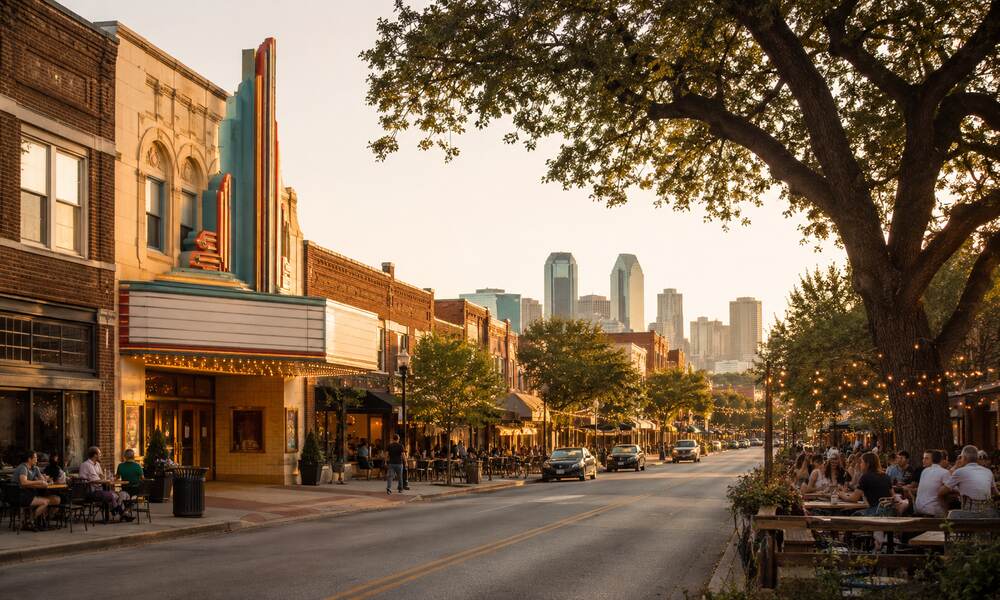
Cross the Trinity River from downtown Dallas and the city changes character. The skyline remains close enough to frame a photograph, yet the streets begin to feel more intimate. Hills rise where visitors expect prairie-flat North Texas. Craftsman homes sit beside Tudor cottages and limestone churches. On Jefferson Boulevard, a 1931 movie palace still throws light across a marquee known around the world. A few blocks away, Bishop Arts crowds its compact sidewalks with pasta, pupusas, books, records, cocktails and people waiting for pie.

Oak Cliff is often introduced as if it were one trendy district. It is actually a large, varied part of southern Dallas made up of many neighborhoods, histories and communities. North Oak Cliff includes places such as Bishop Arts, Kessler Park, Winnetka Heights, Lake Cliff and the Tenth Street Historic District; farther south and west, Oak Cliff extends through communities with identities all their own. The shorthand is convenient, but it can hide the scale of the place—and the generations of Black, Mexican American, Latino and immigrant residents who made it home long before restaurant guides discovered it.
This is a neighborhood where “then” never disappears completely. It survives in old streetcar routes, in commercial blocks along Jefferson, in the surviving homes of a freedmen’s community and in the theater seat associated with Lee Harvey Oswald. “Now” is equally visible: apartments, restored storefronts, chef-driven dining rooms, independent shops and the modern Dallas Streetcar. The most interesting way to see Oak Cliff is to hold both views at once.
Before Oak Cliff: Hord’s Ridge and the Making of a Town
The story begins before the name Oak Cliff existed. By 1845, a settlement known as Hord’s Ridge had formed on the south side of the Trinity River. The ridge offered higher ground above the floodplain and a vantage point toward the young city of Dallas. Development remained modest for decades, but transportation started to change the equation. The Dallas, Cleburne and Rio Grande Railway reached the area in 1880, making the land more accessible and more attractive to speculators.
In 1887, developers Thomas L. Marsalis and John S. Armstrong purchased several hundred acres, including Hord’s Ridge, and renamed the project Oak Cliff. Their ambition was not simply to lay out another subdivision. They marketed an elevated, healthful escape from the noise, smoke and congestion of Dallas—a fashionable residential retreat with the romance of a resort. Sales reportedly topped $60,000 before the end of that first year, a remarkable start for a place that still sat outside the city.
After the partners split, Marsalis pushed the fantasy farther. He promoted a steam railway connecting Oak Cliff with downtown, celebrated as the first elevated railway in the South, although most of its route ran at ground level. He developed Oak Cliff Park, the ancestor of today’s Marsalis Park, with a lake and a large pavilion for dances and performances. His grand Park Hotel, inspired by California’s Hotel del Coronado, offered mineral baths supplied by artesian wells. The pitch combined suburb, spa and pleasure ground.
Oak Cliff incorporated as its own municipality in 1890 with 2,470 residents. It had a mayor, a post office, grocers, meat markets, mills, laboratories and an ice company. But the national financial panic of 1893 crushed the resort economy and drove Marsalis into bankruptcy. The Park Hotel became a college for young women, and the community’s trajectory shifted. Subdivided lots increasingly went to middle- and working-class families rather than wealthy vacationers.
By 1900, Oak Cliff’s population had reached 3,640. Three years later, after several failed attempts, voters approved annexation to Dallas by a margin of only 18 votes. Politically, the independent town vanished. Culturally, it never quite did. Even today, longtime residents frequently speak of going “to Dallas” from Oak Cliff, a small verbal reminder that the river once divided two separate cities.
Streetcars, Porches and Communities Built to Last

Annexation accelerated an era of neighborhood building. Streetcar lines made it practical to live south of the river and work downtown. Winnetka Heights, platted in 1908, filled with broad porches and Arts and Crafts homes. Kessler Park grew along wooded hills and winding roads. Lake Cliff evolved from private amusement grounds into a public park. Jefferson Boulevard matured into a major shopping and entertainment corridor, while smaller commercial pockets served the surrounding blocks.
The built environment is only part of the story. The Tenth Street neighborhood, established after the Civil War by formerly enslaved people and their descendants, became one of Dallas’ most important freedmen’s communities. Residents built homes, churches, businesses and institutions in the shadow of the city’s racial segregation. The district’s surviving shotgun houses and modest cottages document a history very different from the resort imagery used to sell early Oak Cliff. They speak to self-determination, kinship and endurance.
Mexican American families also shaped Oak Cliff’s business corridors, schools, churches, music and food culture across the twentieth century. Jefferson Boulevard became—and remains—a center of Latino commerce. Family restaurants, quinceañera shops, bakeries, taquerias and professional services created a working main street whose importance cannot be measured by tourism alone. Oak Cliff’s contemporary culinary reputation did not appear from nowhere; it grew in soil prepared by generations of neighborhood cooks and entrepreneurs.
Postwar Dallas brought new pressures. Highways and suburban growth redirected investment. Redlining and discriminatory lending restricted where families could buy and borrow. Some commercial strips declined, while demolition and neglect threatened historic buildings. Yet the same relative isolation that limited investment also helped preserve an unusual stock of early-twentieth-century houses and storefronts. Neighborhood activists later used conservation and historic-district designations to protect that character—sometimes imperfectly, but often just in time.
November 22, 1963: Oak Cliff’s Connection to JFK
No account of Oak Cliff can avoid the afternoon of November 22, 1963. President John F. Kennedy was shot while his motorcade traveled through Dealey Plaza in downtown Dallas. The accused assassin, Lee Harvey Oswald, worked at the Texas School Book Depository and lived during the week in a rooming house at 1026 North Beckley Avenue in Oak Cliff. After the shooting, Oswald left downtown by bus and taxi, returned briefly to the rooming house and departed again.
The official account traces him east through Oak Cliff. Near Tenth Street and Patton Avenue, Dallas Police Officer J. D. Tippit stopped him. Tippit was shot and killed shortly after 1 p.m. Witnesses directed police toward Jefferson Boulevard, where Oswald slipped into the Texas Theatre without buying a ticket. Shoe-store manager Johnny Brewer had noticed him acting suspiciously near the entrance and alerted theater employee Julia Postal, who called police.

At about 1:45 p.m., officers entered the darkened auditorium during a screening of War Is Hell. Brewer pointed out Oswald near the rear. A struggle followed, and police arrested him. Oswald was initially taken into custody in connection with Tippit’s murder and was later charged with Kennedy’s assassination. He denied the accusations and was killed by Jack Ruby two days later before a trial could take place. The Warren Commission concluded that Oswald acted alone; debate and conspiracy theories have continued for more than six decades.
For Oak Cliff, the events created an unwanted geography of remembrance: the Beckley rooming house, the Tippit scene and the Texas Theatre. Visitors still retrace the route, but these are not abstract stops on a mystery tour. Tippit was a real officer who died on a residential street. Theater employees and neighborhood witnesses were suddenly pulled into a national trauma. Thoughtful visitors treat the sites with the gravity they deserve.
The connection also changed how the outside world saw Oak Cliff. A neighborhood that had spent decades developing its own civic and commercial life became reduced in many accounts to the place where Oswald was captured. The fuller story is more complicated. The assassination is part of Oak Cliff history, but Oak Cliff is not merely a backdrop to the assassination.
The Texas Theatre: From Movie Palace to Living Landmark
The Texas Theatre deserves attention beyond its famous arrest. It opened at 231 West Jefferson Boulevard on April 21, 1931, the dream of Oak Cliff entrepreneur C. R. “Uncle Mack” McHenry. Architect W. Scott Dunne designed a lavish Venetian-inspired auditorium with opera boxes, fountains, a chandelier and a ceiling animated by projected clouds. It was the largest suburban movie house and the third-largest theater in Dallas.
It was also technologically ambitious: built for talking pictures, equipped with a major Barton organ and promoted as Dallas’ first air-conditioned theater. For Depression-era audiences, the Texas offered both modern engineering and escapist spectacle. Howard Hughes briefly had an ownership connection through the Robb & Rowley theater chain during the building’s early period—an appropriately cinematic footnote.
After 1963, the building underwent a dramatic redesign that concealed much of its original ornament. As moviegoing shifted to drive-ins and multiplexes, attendance declined. United Artists closed the theater in 1989. Preservation groups and individual owners repeatedly saved it, even as mortgage trouble, vacancy, vandalism and a 1995 fire threatened its survival. Oliver Stone altered the exterior to recreate its 1963 appearance for his film JFK, adding another layer to the building’s relationship with the assassination.
The Oak Cliff Foundation acquired the property in 2001, and the Texas Theatre joined the National Register of Historic Places in 2003. Aviation Cinemas began a new operating era in 2010 and later acquired the property. A multimillion-dollar expansion completed in 2021 added a second auditorium, balcony seating and an upstairs bar while preserving the main house. Today, the Texas screens first-run and repertory films, hosts concerts and special events, and projects both 35mm film and digital cinema. It is not a memorial frozen in 1963. It is a working neighborhood theater—arguably the best possible outcome for a historic building.
From Forgotten Storefronts to Bishop Arts

Bishop Arts began as a small streetcar-era commercial district at Bishop Avenue and Davis Street. By the 1970s and early 1980s, many storefronts were vacant or neglected. Local entrepreneurs, property owners and neighborhood advocates slowly restored the compact blocks. The name “Bishop Arts District” helped give the area a marketable identity, but its revival was built shop by shop, not delivered all at once.
That small scale became the district’s advantage. A visitor could park once and walk among restaurants, galleries, boutiques and bars—an unusual experience in car-oriented Dallas. Independent businesses created personality that no master-planned development could duplicate. The district became a destination, and its success radiated outward along Davis and into nearby streets.
Success brought complications. New apartments and higher-end development added customers and housing, but also raised rents and land values. Businesses that helped establish the district sometimes found it difficult to remain. Longtime residents watched “Oak Cliff” become a lifestyle brand, often stripped of the communities that sustained the area during leaner decades. The central question of Oak Cliff now is not whether change will occur. It is who gets to participate, who benefits and what can be preserved.
Visitors can help by treating Oak Cliff as a neighborhood rather than a set. Spend beyond the most photographed blocks. Shop locally. Learn the history of Tenth Street and Jefferson Boulevard. Remember that a charming old building is not only an aesthetic; it may represent a family’s work, a congregation’s survival or a community’s fight against demolition.
Oak Cliff’s Restaurant Scene: New Energy, Deep Roots
Food is now one of Oak Cliff’s biggest draws, and the range is the point. The neighborhood can offer a destination tasting experience, a tray of smoked meat, blue-corn enchiladas, a carefully made cocktail or a nostalgic bowl of cereal—sometimes within a few walkable blocks.
Lucia and the rise of destination dining
Lucia, David and Jennifer Uygur’s intimate Italian restaurant, became one of the restaurants that changed how the wider region talked about Bishop Arts. Its house-cured salumi, handmade pasta and focused wine list turned a small historic storefront into one of Dallas’ most sought-after reservations. Lucia’s importance is larger than any ranking: it proved that an ambitious, personal restaurant could become a citywide destination while still feeling embedded in Oak Cliff.
Modern Mexican cooking and neighborhood hospitality
At El Carlos Elegante, live-fire cooking and a moody, theatrical room reinterpret Mexican flavors through a contemporary Dallas lens. Veracruz Café represents another essential thread, serving dishes influenced by the cuisine of Veracruz, including blue-corn enchiladas. Gloria’s Latin Cuisine, which grew from its original Oak Cliff location, is a reminder that pupusas and Salvadoran flavors were drawing loyal local crowds before Bishop Arts became a national travel recommendation.
Beatrice, Encina and a broader definition of Texas food
Restaurant Beatrice has brought a contemporary Cajun and Creole perspective to Oak Cliff, with an emphasis on regional ingredients and the traditions behind the food. Encina, in the former Bolsa space, serves seasonal New American cooking in a relaxed neighborhood setting. Both reflect a maturing restaurant landscape: polished enough for a special night, but grounded in hospitality rather than spectacle alone.
Barbecue, pizza, brunch and sweets
Lockhart Smokehouse helped make Central Texas-style barbecue part of the Bishop Arts draw. Eno’s Pizza Tavern remains a dependable gathering place, while Oddfellows helped define the district’s all-day brunch-and-coffee rhythm. Emporium Pies turned a restored Victorian house into one of the area’s sweetest landmarks. CocoAndré Chocolatier, a Latina-owned family business associated with mother-and-daughter chocolatiers Andrea Pedraza and Cindy Pedraza, connects craft chocolate to Mexican heritage. Newer, more playful concepts such as The Spelled Milk—a cereal bar with an enormous international selection—show that Oak Cliff still has room for ideas that sound improbable until someone makes them work.
Restaurants change quickly, especially in a district facing rising costs. Check official websites and social pages for current hours, reservations and locations before making a special trip. That practical note is also historical: Oak Cliff’s commercial life has always been cyclical, with beloved institutions closing as new ones take their place.
Notable Businesses and Cultural Anchors
Oak Cliff’s appeal is not limited to eating. The neighborhood’s best businesses create places to linger, talk and encounter something unexpected.
The Wild Detectives, opened in 2014 by Spanish civil engineers and friends Javier García del Moral and Paco Vique, combines an independent bookstore, bar and cultural venue in a small house on West Eighth Street. Readings, music, festivals and conversations are not side programming; they are the business model. It has become the kind of “third place” every neighborhood wants and few can manufacture.
The Kessler Theater carries forward Oak Cliff’s performance tradition in a historic building on West Davis Street. Its intimate concert room attracts touring artists while retaining the scale of a neighborhood venue. Spinster Records keeps record-store culture alive in Bishop Arts, and We Are 1976 showcases design-minded gifts and prints. Bishop Street Market, M’antiques and independent boutiques provide the browse-and-discover experience that makes the district work between meals.
Another Round adds mini golf, drinks and an upbeat social setting to West Davis. Jefferson Boulevard offers an entirely different retail experience, with long-established Latino businesses, apparel and special-occasion shops. The distinction matters. Bishop Arts may be Oak Cliff’s best-known visitor district, but it is only one chapter in a much larger commercial story.
Oak Cliff Now: Connected Again, Still Independent
The Dallas Streetcar, opened in 2015 and later extended to Bishop Arts, restored a rail connection between downtown and Oak Cliff more than a century after Marsalis promoted his own line. The vehicles and city around it are new, but the underlying idea is remarkably old: Oak Cliff becomes more accessible without giving up its separation.
That renewed connection has accelerated investment. Restored homes, apartments and mixed-use projects bring residents and tax revenue. They also intensify debates over affordability, demolition and cultural erasure. Preservation cannot mean protecting only grand houses or photogenic storefronts. It must include modest homes, historic Black neighborhoods, Latino commercial corridors and the ability of longtime residents to remain.
Oak Cliff’s greatest asset has never been a single attraction. It is the habit of reinvention. A failed resort became a working-class town. A streetcar suburb became a collection of resilient urban neighborhoods. A movie palace survived closure, fire and near-demolition to become a beloved cinema again. Empty storefronts became a walkable arts district. Old houses became bookstores, restaurants and gathering places.
The danger is that reinvention can become replacement. The best version of Oak Cliff’s future will not polish away the contradictions. It will protect the architecture without turning the neighborhood into a museum, welcome successful businesses without crowding out local entrepreneurs, and invite newcomers to participate without asking longtime communities to disappear.
A History-Minded Oak Cliff Day
- Morning: Walk Lake Cliff Park and look toward the downtown skyline across the Trinity corridor.
- Late morning: Explore the residential architecture of Winnetka Heights, respecting private homes and residents.
- Lunch: Choose a locally owned restaurant on Jefferson Boulevard, in Bishop Arts or along Davis Street.
- Afternoon: Visit the Texas Theatre and note the nearby sites connected to the events of November 22, 1963.
- Browse: Stop at The Wild Detectives, a record shop, chocolatier or neighborhood boutique.
- Evening: Book dinner, then see a film at the Texas or a concert at the Kessler.
Why Oak Cliff Still Matters
Oak Cliff matters because it complicates the usual story of Dallas. The city is famous for speed, new construction and a willingness to replace yesterday with tomorrow. Oak Cliff shows another Dallas: one that adapts old buildings, argues over memory, builds culture from the neighborhood outward and remains suspicious of anything too polished to be real.
Come for the Texas Theatre marquee, the plate everyone is talking about or the colorful Bishop Arts storefronts. Then look longer. Notice the rise of the land above the river. Imagine the steam railway and the Park Hotel. Remember the freed families who built Tenth Street, the immigrant entrepreneurs who made Jefferson a main street, the witnesses pulled into history in 1963 and the preservationists who refused to let a theater fall.
Oak Cliff then was never one thing, and Oak Cliff now is not one thing either. It is old Dallas and new Dallas, grief and celebration, neighborhood and destination. Its story continues because people keep finding ways to use the past without living inside it.
Sources and Further Reading
This feature was fact-checked against the Texas State Historical Association’s Handbook of Texas, the Texas Theatre’s official history, the City of Dallas Tenth Street Historic District resource, The Sixth Floor Museum at Dealey Plaza, Visit Dallas and official business websites. Restaurant and shop details are current to August 2026 but may change.