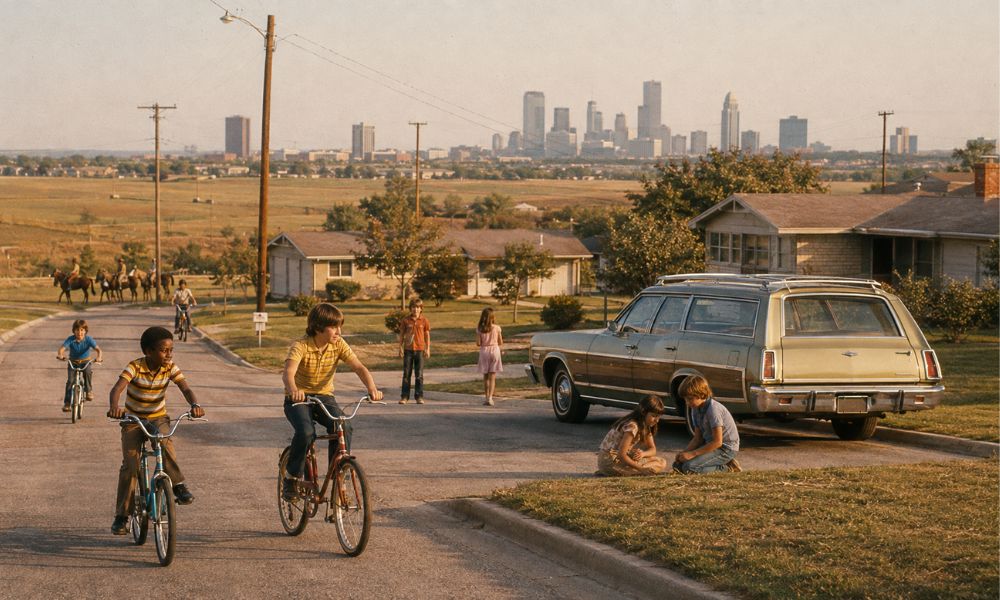
I was born in Dallas, Texas, in 1954 at Methodist Hospital in Oak Cliff. More than 70 years later, Methodist Hospital is still there, caring for new generations of Dallas families. Much of the surrounding area has changed, but parts of Oak Cliff—especially around Lake Cliff—still look familiar to me.
When I drive through that area today, I can still make out pieces of the Dallas I knew as a child. The buildings are older, many of the businesses have changed, and there are more cars on the streets, but the basic character of the neighborhood remains. Every once in a while, I see an old house, a familiar street or a building that brings back a memory I had not thought about in years.
That is one of the interesting things about growing older in the same area where you were born. You do not see only what is there today. You also see what used to be there.
Modern Dallas–Fort Worth has been built over the place where I grew up, but the old Metroplex has not completely disappeared. You can still find it if you know where to look.
Television Was a Special Event
Growing up in Dallas during the 1960s was very different from growing up here today. We did not have computers, cellphones, video games, streaming services or the internet. Most families had one television, and that television was usually in the living room where everyone watched it together.
We received only about five television channels. Channel 13 was the public broadcasting station, supported by donations from viewers. During pledge drives, regular programming would be interrupted while someone asked people to contribute money to keep the station operating.
We certainly did not have hundreds of channels with programs available around the clock. If a show came on at a certain time, you needed to be sitting in front of the television at that time. You could not record it, pause it or watch it later. If you missed it, you simply missed it.
Before school, I remember watching The Three Stooges. Mr. Peppermint and Icky Twerp were two of the local television personalities Dallas–Fort Worth children knew and loved. To us, they were celebrities. They came into our homes through the television and became part of our childhood.
Television reception was not always dependable. The picture might become fuzzy, begin rolling or suddenly disappear. Someone would have to adjust the antenna while another person watched the screen and shouted instructions.
“A little more. No, go back. That’s it—don’t move!”
Sometimes just getting a clear picture required the cooperation of the entire family.
We watched television, but it did not occupy every minute of the day. When the programs we wanted to see were over, we turned off the television and found something else to do.
School Was Very Different
School in the 1960s was nothing like school today. Teachers and principals were allowed to discipline students with wooden paddles. We called it “getting licks.”
If you talked back, broke a rule, fought with another student or caused too much trouble, you might be sent to the principal’s office. Getting sent to the office was serious because you knew the paddle might be waiting for you.
People sometimes claim that corporal punishment made every student behave and work harder. That was not always true. It certainly did not cause me to do well in school. Some children responded to that kind of discipline by becoming obedient. Others became nervous, discouraged, angry or disconnected from school.
Children were expected to follow instructions without asking many questions. The adults were in charge, and everyone knew it. Students stood in lines, remained quiet in class and asked permission to do almost everything.
We did not have computers in our classrooms. Research meant going to the library, locating a book and finding the information yourself. If you needed to write a report, you wrote it by hand or typed it on a typewriter. Correcting a mistake was not as simple as pressing the backspace key.
School life also revolved around the local community. Football games, band concerts, school plays and other activities brought families together. In a small town, many people knew the students, teachers and coaches. What happened at school became news throughout the community.
A Collection of Small Towns
There was Dallas, and there was Fort Worth. Between them and around them were more than 50 smaller communities that eventually became part of what we now call the Dallas–Fort Worth Metroplex.
Today, DFW feels like one continuous urban area. You can drive from one city into another without realizing you have crossed a city limit. Shopping centers, subdivisions, restaurants, office buildings and warehouses stretch for miles.
That was not the case when I was growing up.
Places such as DeSoto, Duncanville, Cedar Hill, Lancaster, Irving, Arlington, Grand Prairie, Carrollton and Richardson felt like separate towns. You could leave one community, drive through open countryside and eventually arrive in another.
When I attended school in DeSoto, the town had a population of only around 5,000 people. It is difficult to imagine that today. There were open fields, pastures and undeveloped land all around us. Roads that now carry thousands of cars were once quiet country roads.
The individual communities had their own personalities. Residents shopped at local businesses, attended local churches and followed local school sports. People often knew the owners of the stores they visited. They might also know the police officer, the school principal and the person working behind the counter at the drugstore.
The Metroplex was growing, but it had not yet become the enormous metropolitan area we know today.
We Created Our Own Entertainment
There was no internet, so if we wanted entertainment, we created it ourselves.
Children spent a lot of time outdoors. We rode bicycles, played ball, explored fields, built forts and invented games. A vacant lot could become almost anything. One day it was a baseball field. The next day it was a battlefield, a ranch, an unexplored wilderness or another planet.
A bicycle could become a motorcycle, a race car or a horse. A cardboard box could become a spaceship. A stick might become a sword, a rifle or a magic wand.
We did not need expensive equipment. We needed friends, open space and imagination.
Parents did not always know exactly where their children were. We might leave the house in the morning, return for lunch and then disappear again until supper. There were no cellphones, text messages or electronic location trackers.
We understood that we were supposed to be home by a certain time. For many children, the streetlights served as the signal that the day’s adventures were over.
If you wanted to talk to a friend, you called the family telephone. It was usually attached to the wall, and everyone nearby could hear your half of the conversation. If another family member was already using the phone, you waited.
When you called a friend, one of their parents might answer. That meant children learned how to introduce themselves and politely ask to speak with someone. There was no texting a friend without interacting with the rest of the family.
A Trip to Six Flags Over Texas
One of the most exciting places for a child in the Metroplex was Six Flags Over Texas in Arlington. Six Flags opened in 1961, and it was more than an amusement park to us. It was a place where history, fantasy and adventure all came together.
A trip to Six Flags was not something we treated casually. It was a major outing. You anticipated it before you went, enjoyed every minute while you were there and talked about it after you returned home.
As you approached the park, the excitement grew. Once inside, there were rides, shows, costumed characters and attractions unlike anything we normally saw. Each section of the park had its own theme, making it feel as if you were traveling through different parts of Texas history.
The rides seemed enormous and daring. Even waiting in line was part of the experience because you could hear the machinery, the music and the screams of riders ahead of you. Some children wanted to ride everything. Others had to build up their courage.
The park offered something we could not create in a vacant lot or backyard. It took the stories and adventures we imagined and turned them into something we could see, hear and experience.
Six Flags also represented the growth of the region. Arlington sat between Dallas and Fort Worth, and the park gave families from both cities a reason to meet in the middle. It became one of the attractions that helped connect the two sides of the Metroplex.
For generations of North Texas children, summer would not have felt complete without at least dreaming about a trip to Six Flags.
Going to the Zoo
Trips to the zoo were another special part of growing up in DFW. We had the Dallas Zoo and the Fort Worth Zoo, and visiting either one could fill an entire day.
A zoo visit allowed us to see animals we knew only from books and television. Elephants, lions, giraffes, monkeys and other animals suddenly became real. They moved, made noise and occasionally smelled much stronger than we expected.
For a child, the zoo was an adventure. You walked from one exhibit to another, wondering what you would see next. There was always one animal everyone wanted to find and another that became an unexpected favorite.
The zoos of that era were different from the large, natural-looking habitats common today. Many animals lived in smaller and simpler enclosures. People did not understand animal welfare and conservation in quite the same way they do now.
Even so, visiting the zoo could inspire a lifelong interest in animals and the natural world. It showed children that the world was much larger than their own neighborhoods.
A trip to the zoo was also a family experience. We did not rush through while staring at phones. We looked at the animals, read the signs, talked to one another and tried to remember where we had parked the car.
Those ordinary family outings often became the memories that lasted.
Fishing at the Lake Dallas Barge
Another place I remember was the fishing barge at Lake Dallas.
Fishing from a barge offered a different kind of entertainment. It was quieter than Six Flags and less exotic than the zoo, but it had its own sense of adventure.
There was something exciting about standing over the water with a fishing pole, never knowing what might be swimming below. You baited the hook, dropped the line and waited. Sometimes something pulled on it, and sometimes nothing happened for a long time.
Waiting was part of fishing. It gave people time to talk, joke, watch the water and enjoy being together. Children learned patience—or at least adults hoped they would.
The Lake Dallas fishing barge attracted families and fishermen who wanted access to deeper water without owning a boat. You could bring your equipment, find a place along the railing and spend hours trying your luck.
The barge had its own sounds and smells: water moving underneath, boards creaking, fishing reels clicking, bait, lake water and the occasional excitement when someone caught something.
For a child, even a small fish could feel like a trophy. You did not need to catch the biggest fish in the lake. The thrill came from feeling that tug on the line and wondering what would appear when you reeled it in.
Lake Dallas felt farther away from the city than it does today. Development had not yet surrounded as much of the lake, and a fishing trip could make you feel as if you had left the Metroplex behind.
Today, entertainment is often designed to provide immediate excitement. Fishing was different. It required you to slow down and pay attention. The experience was not only about catching fish. It was about the trip, the people you were with and the stories you told afterward.
Cars, Roads and Getting Around
Driving around DFW was different too. There were fewer highways, fewer cars and much less traffic. Paper maps and road signs were your navigation system.
If you became lost, you stopped at a gas station and asked for directions. The instructions might include instructions such as, “Turn left by the old red barn,” even if the barn had disappeared years earlier.
Gas stations provided actual service. An attendant might pump your gas, clean the windshield and check under the hood. Cars were larger, heavier and less efficient. They did not have navigation screens, backup cameras, Bluetooth connections or many of the safety features people expect today.
Seat belts were not always used, and children sometimes rode in places that would horrify modern parents. We thought nothing of it because it was normal at the time.
The roads between communities passed through fields and undeveloped areas. Traveling from southern Dallas County to Arlington, Fort Worth or Lake Dallas could feel like a genuine trip.
Today, the same journey may pass through miles of continuous development.
The Airport That Changed Everything
Before DFW International Airport opened, Love Field was Dallas’s primary airport, while the Fort Worth area had its own aviation facilities.
Dallas and Fort Worth were neighboring cities, but they were also competitors. Each wanted businesses, visitors and recognition. Building one enormous airport between them required the two cities to cooperate.
When Dallas–Fort Worth International Airport opened in 1974, it changed the future of North Texas. The airport brought jobs, travelers, companies and development. Communities near the airport began growing rapidly.
The once-open land between Dallas and Fort Worth gradually filled with homes, hotels, offices, restaurants and warehouses. The name “DFW” became known around the world.
We did not fully understand what was happening at the time. We were watching Dallas and Fort Worth grow together into one of the largest metropolitan areas in the United States.
To us, however, it was simply home.
What Changed—and What Remains
The Metroplex continued to change throughout the 1970s. New highways opened, shopping malls became popular and subdivisions replaced fields. Professional sports became a larger part of local identity. National and international companies moved into the area, bringing thousands of new residents with them.
Not everything about the old days was better.
Segregation and discrimination affected people across North Texas. Opportunities were not equally available to everyone. Cars and workplaces were less safe. Medical treatment was less advanced, and certain methods of school discipline would be unacceptable today.
Nostalgia can cause us to remember the pleasant parts of the past while forgetting its problems. It is important to remember both.
Still, there are things I miss.
I miss the open land between the towns. I miss the slower pace and the feeling that an ordinary afternoon could become an adventure. I miss the local television personalities everyone recognized. I miss the excitement of a family trip to Six Flags, a day at the zoo or a fishing trip to the Lake Dallas barge.
I miss the freedom children had to explore and create their own entertainment. We did not need to be connected to the entire world every minute. Sometimes our whole world consisted of a few neighborhood friends, some bicycles and whatever adventure we invented that day.
The Dallas–Fort Worth Metroplex where I grew up has not completely disappeared. You can still find pieces of it in Oak Cliff, around Lake Cliff and in the older parts of the small towns that once surrounded Dallas and Fort Worth.
You might discover it in an old building, a faded sign, a quiet residential street, a former country road or a local business that has somehow survived while everything around it changed.
You can still make out the older things that make up the Metroplex, but you must look hard. Modern DFW has grown over them, around them and sometimes directly through them.
Yet the old Metroplex survives in more than buildings and roads. It lives in the memories of those of us who grew up here.
Sometimes all it takes is an old photograph, the theme song from a television program, the sight of a fishing pole or the distant sound of children riding bicycles to bring everything back.
For just a moment, the highways disappear. The shopping centers become open fields again. The small towns separate from one another, and the Metroplex becomes the place I knew as a child.
It was smaller, quieter and far from perfect—but it was home.