The History of Southlake, Texas: From Rural Crossroads to a Signature North Texas Suburb
Southlake, Texas sits in the heart of the Dallas–Fort Worth metroplex, close enough to feel the region’s economic pulse but distinct enough to have built a strong identity of its own. Today it’s widely known for high-performing schools, upscale neighborhoods, and a thriving mixed-use “downtown” that didn’t exist a few decades ago. Southlake’s story is a classic North Texas transformation: open land and small settlements gave way to lake recreation, then airport-driven growth, and finally a carefully planned community that attracted both families and corporate employers.
Before “Southlake”: Native land, early settlers, and small communities
Long before the city existed, the area that would become Southlake was part of a broad North Texas landscape used by Native peoples, including Comanche and Kiowa groups who moved through and hunted in the region. (visitsouthlaketexas.com)
In the 1840s, pioneers began settling the area in pockets that were more like rural neighborhoods than a single town. Southlake’s visitor-history overview notes that the area was settled by pioneers in the 1840s, but it remained unincorporated for more than a century afterward. (visitsouthlaketexas.com) Those early communities included places like Dove, Jellico, Union Church, and Whites Chapel—names that still echo in local landmarks and church sites. (visitsouthlaketexas.com)
A key example of early community life was the establishment of Lonesome Dove Baptist Church in the 1840s, a reminder of the faith-based institutions that helped anchor scattered settlers. (visitsouthlaketexas.com) Schooling also evolved from one-room schools into more centralized education with the opening of Carroll Hill School in 1919 (a building that still stands), reflecting the gradual shift from isolated homesteads to a more connected rural community. (visitsouthlaketexas.com)
Grapevine Lake and a reason to protect the “country” lifestyle
A major turning point for the area was the creation of Grapevine Lake in the early 1950s. Southlake’s tourism history notes that the city wasn’t incorporated until 1956—four years after Grapevine Lake was finished—and that the lake’s recreational opportunities helped attract residents who wanted country living with access to outdoor fun. (visitsouthlaketexas.com)
That timing mattered. During the mid-20th century, North Texas cities and small towns were expanding and annexation was a constant worry for rural residents. For people who liked open land, fewer regulations, and a quieter way of life, incorporation could be a defensive move: form a city, set boundaries, and control your own future.
Incorporation in 1956: a small town by design
Southlake officially incorporated on September 25, 1956, after residents petitioned for a vote and (famously) rushed paperwork to Austin to make it happen. (Southlake History) The measure passed by a close vote, and the town began as a very small place—about 1.62 square miles with roughly 200 residents. (Southlake History)
One charming detail from the Southlake Historical Society: the first mayor was A. Gail Eubanks, and the name “Southlake” was reportedly suggested by the mayor’s daughter. (Southlake History) From the start, the intent wasn’t to become “big”—it was to stay livable. The incorporation documents even included the line, “All of us live here because we like it,” capturing that early civic mindset. (Southlake History)
The airport era: how DFW changed everything
For years after incorporation, Southlake stayed largely rural. The big catalyst was Dallas Fort Worth International Airport, completed in the 1970s. Southlake’s official visitor history says the area remained rural until the airport’s completion, and then—because of its proximity—Southlake became a “boom-burb” through the 1980s, 1990s, and 2000s. (visitsouthlaketexas.com)
That makes intuitive sense: airports create jobs directly (airlines, logistics, services) and indirectly (corporate offices, hotels, suppliers). And they make business travel easier—an important factor for companies choosing office locations. Southlake found itself in a sweet spot: near DFW Airport, but with the space and political will to shape development carefully.
Planning and infrastructure: annexation, utilities, and a “blank canvas”
The Southlake Historical Society describes a key phase in the late 1980s and beyond: a Home Rule Charter passed in 1987, and the city pursued infrastructure improvements like sewer and water arrangements that allowed more planned growth. (Southlake History) A former mayor quoted in the Historical Society narrative described Southlake as having a “blank canvas,” emphasizing that the community could decide what to approve—and what to reject—as proposals came in. (Southlake History)
That “choose your future” approach became part of Southlake’s modern identity: not just growth, but curated growth.
Town Square: building a downtown from scratch
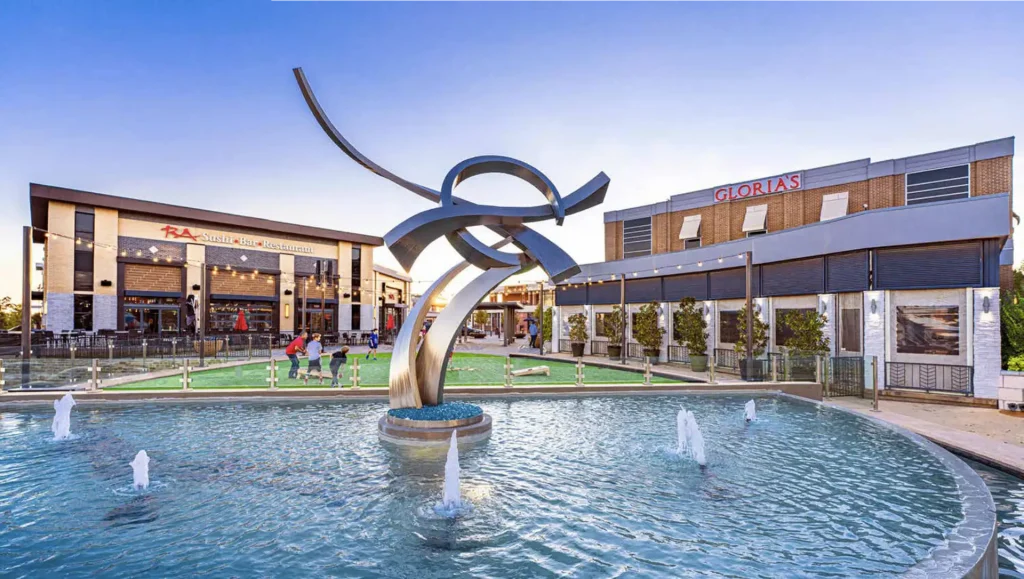
Perhaps the most visible symbol of Southlake’s evolution is Southlake Town Square—an intentionally created, mixed-use downtown district rather than a historic main street that grew organically.
According to the Southlake Historical Society, the “first phase” of Town Square opened in 1999, and its centerpiece—Town Hall—became home to city offices and the library. (Southlake History) The Town Hall design was even inspired by historic Texas courthouses, linking a brand-new development to classic civic architecture. (Southlake History)
Town Square did more than add shopping and restaurants; it created a shared civic living room. In many suburbs, people drive to other cities for a night out or to run errands. Town Square helped Southlake keep more daily life—dining, shopping, events, public services—within its own boundaries.
Who lives in Southlake today?
Southlake’s demographics reflect a family-oriented, highly educated community with high homeownership and strong household income:
Population: 31,500 (July 1, 2024 estimate). (Census.gov)
Growth: +0.7% from April 2020 to July 2024 (a sign of slower, mature-suburb growth rather than explosive expansion). (Census.gov)
Age mix: 31.4% under 18; 13.4% age 65+. (Census.gov)
Households: 3.31 persons per household (larger than many suburbs, consistent with families). (Census.gov)
Homeownership: 95.5% owner-occupied housing rate (2019–2023). (Census.gov)
Education: 74.7% of adults 25+ have a bachelor’s degree or higher (2019–2023). (Census.gov)
Race & ethnicity (selected): 73.6% White alone; 15.7% Asian alone; 9.1% Hispanic or Latino; 1.8% Black alone. (Census.gov)
Foreign-born: 16.3% (2019–2023). (Census.gov)
In plain terms: Southlake is a relatively stable-sized city with a strong concentration of families, college-educated adults, and homeowners. It’s also more diverse than many people assume at a glance, particularly with a significant Asian population share. (Census.gov)
Income and “average” prosperity
Southlake is one of the highest-income communities in the region, and the numbers are striking:
Median household income (2019–2023, inflation-adjusted to 2023 dollars): $250,000+ (Census.gov)
Per capita income (2019–2023, 2023 dollars): $117,219 (Census.gov)
Poverty rate: 2.0% (Census.gov)
Because the Census “median household income” is capped in the QuickFacts display at $250,000+, the true median may be above that threshold—but the key takeaway is that Southlake sits in the top tier nationally by household income. (Census.gov)
Housing costs match that prosperity: the median value of owner-occupied housing units is listed at $957,500 (2019–2023). (Census.gov)
What industry is in Southlake?
Southlake’s economy is a blend of corporate offices, professional services, and high-end retail and hospitality—supported by access to DFW Airport and the larger metroplex.
One well-known corporate anchor is Sabre Corporation, a travel technology company headquartered in Southlake. (Wikipedia) The presence of corporate employers like this helps explain the city’s strong professional workforce profile.
Looking at the industries where Southlake residents commonly work, Data USA lists top employment sectors including:
Professional, Scientific & Technical Services
Finance & Insurance
Health Care & Social Assistance (Data USA)
That pattern fits a community where many people commute to nearby job centers (Las Colinas, Downtown Dallas, Fort Worth, Westlake, and other corporate corridors), while Southlake itself offers premium office campuses, services, and a major retail hub.
And that retail hub is significant. The Census QuickFacts economic figures report total retail sales of $1,365,818,000 (2022) and retail sales per capita of $43,890 (2022)—very high figures for a city of ~31,500, reflecting Southlake’s regional pull as a shopping and dining destination. (Census.gov)
How fast is Southlake growing now?
Southlake’s growth today looks different than it did during the big “boom-burb” decades. The city expanded rapidly as DFW Airport reshaped the region and as North Texas suburban development surged. In more recent years, Southlake has shifted into a steadier, mature phase:
2010 Census: 26,575
2020 Census: 31,265
2024 estimate: 31,500 (Census.gov)
That’s strong decade growth from 2010 to 2020, followed by relatively modest change since 2020 (+0.7% to mid-2024). (Census.gov) In practical terms, Southlake is less about adding huge new subdivisions now and more about maintaining quality, redeveloping strategically, and continuing to attract high-value businesses and amenities.
Why Southlake became “Southlake”
Put all the pieces together and Southlake’s rise makes sense:
A desirable location between Dallas and Fort Worth and close to major airports. (visitsouthlaketexas.com)
Early incorporation to control annexation and shape development locally. (Southlake History)
Infrastructure and planning choices that enabled growth while keeping a high standard for what got built. (Southlake History)
A deliberate town center (Town Square) that created identity and regional attraction. (Southlake History)
An economy tied to professional services, corporate offices, and destination retail, supported by a high-income, highly educated resident base. (Census.gov)
Southlake today: a curated suburb with a long view
Southlake started as scattered settlements and ranch land, incorporated in 1956 as a small town of about 200 residents, and stayed rural until the airport era opened the door to rapid suburban growth. (Southlake History) Over time it evolved into a community that treats planning as a core value—one that built its own downtown, attracted corporate anchors, and became one of the most affluent cities in the region. (Southlake History)