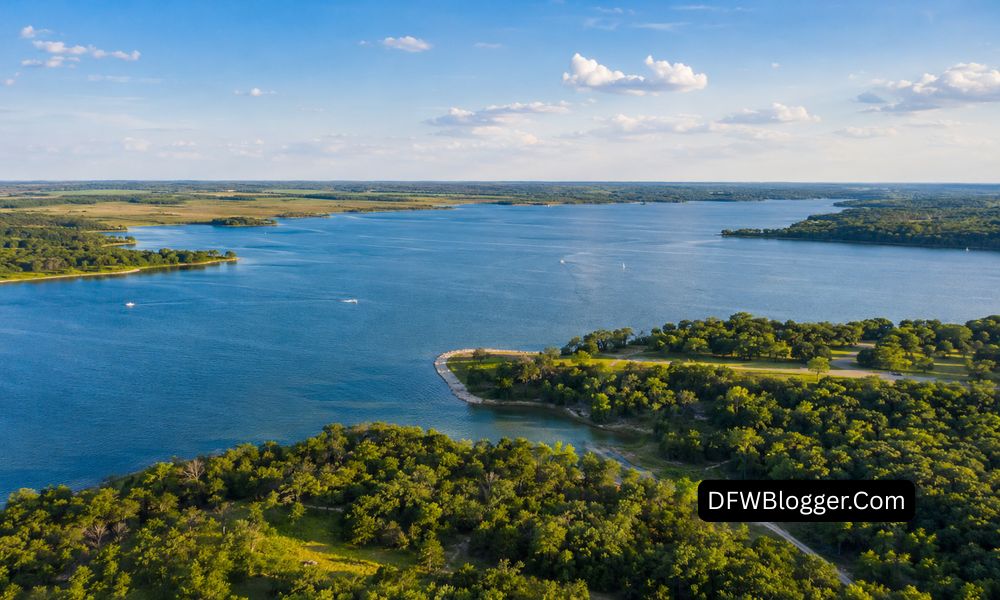
Today, Joe Pool Lake is one of the most popular outdoor destinations in the Dallas–Fort Worth area. Families visit its parks, boaters cross its open water, and anglers fish around submerged trees, old roadbeds, bridges, and stock ponds.
However, Joe Pool Lake is not a natural lake. It is a reservoir created by damming Mountain Creek and Walnut Creek. Its construction required decades of planning, political support, engineering, land acquisition, and persistence.
Long before the first boats appeared, the land beneath the lake contained farms, pastures, roads, creeks, trees, homesites, and traces of people who had lived there centuries earlier.
What Was There Before Joe Pool Lake?
Before the reservoir was built, the area was primarily rolling North Texas prairie, farmland, cattle pasture, wooded creek bottoms, and rural property. Mountain Creek and Walnut Creek flowed through the land, eventually carrying water northward toward the Trinity River system.
Some families had farmed and raised livestock in the area for generations. Remnants of that agricultural past can still be seen at Penn Farm Agricultural History Center in Cedar Hill State Park. John Wesley Penn established the farm in 1859, and the Penn family continued farming and raising cattle there for more than a century.
The construction project also led to extensive archaeological investigations. Beginning in 1974, Southern Methodist University worked under contract with the U.S. Army Corps of Engineers to study sites that could be affected by the reservoir.
Researchers found evidence that people had occupied the region long before modern settlement. At the Cobb-Pool archaeological site, researchers uncovered evidence of an early Caddo settlement, including pottery, stone tools, a roasting pit, postholes from structures, and other artifacts. Archaeologists examined and documented these locations before rising water permanently changed the landscape.
Not everything beneath the lake was removed. Numerous stock ponds, roadbeds, bridges, and other features remained in place. Trees were cleared from portions of the main lake, but many were left standing in its upper branches to provide fish habitat. These submerged features help explain why Joe Pool Lake developed into a productive fishing destination.
Why Was the Lake Built?
The main reason for building Joe Pool Lake was flood control.
Heavy rainfall within the Mountain Creek and Walnut Creek watersheds could send water downstream and threaten farms, homes, roads, and other property. A reservoir could capture part of that runoff and release it more gradually, reducing the risk of destructive flooding.
The project was designed for several additional purposes:
Municipal water supply
Outdoor recreation
Fish and wildlife conservation
Management of water within the Trinity River Basin
The growing southern portion of the Dallas–Fort Worth area also needed long-term water resources. Joe Pool Lake eventually became part of the region’s water-supply system, including service to the City of Midlothian.
Recreation was another important part of the plan. Parks, camping areas, swimming beaches, fishing access, boat ramps, trails, and wildlife areas were incorporated into the development around the reservoir.
Who Was Joe Pool?
Joe Richard Pool was born in Fort Worth on February 18, 1911, and grew up in the Dallas area. He became an attorney, businessman, state legislator, and Democratic member of the United States House of Representatives.
Pool served three terms in the Texas House of Representatives during the 1950s. While serving in the state legislature, he co-sponsored the 1955 legislation that created the Trinity River Authority.
He was later elected to Congress and represented Texas from 1963 until his death in 1968. For part of that time, he served as a congressman-at-large, meaning that he represented the entire state rather than a single congressional district. He later represented a district covering western Dallas County.
Pool strongly supported water-development and flood-control projects. He played an important role in obtaining congressional authorization and federal support for the proposed reservoir on Mountain Creek.
Congress authorized the project in 1965. At the time, it was known as Lakeview Lake or Lakeview Reservoir.
Joe Pool died unexpectedly of a heart attack in Houston on July 14, 1968. He never lived to see construction begin. Supporters continued working on the project, however, and the Lakeview Planning Council helped keep it alive through years of delays.
In 1982, President Ronald Reagan signed legislation officially changing the project’s name from Lakeview Lake to Joe Pool Lake, honoring the congressman who had championed it.
The Biographical Directory of the United States Congress provides additional information about Pool’s public service.
When Did Construction Begin?
Although Congress authorized the reservoir in 1965, actual construction did not begin until 1977—12 years later.
Building a reservoir of this size required much more than putting a dam across a creek. Engineers had to study the watershed, purchase land, relocate or modify roads and utilities, conduct archaeological investigations, clear selected portions of the future lake bottom, build bridges, construct recreational facilities, and complete the dam and spillway.
The dam is an enormous rolled-earth embankment. It stretches approximately 4.2 miles and reaches a maximum height of about 108 feet above the original streambed. A concrete spillway allows excess water to pass safely when the lake rises.
Major construction was completed in December 1985. The gates were closed and water impoundment began in January 1986.
The lake did not fill immediately. Rainfall and runoff gradually filled the reservoir over the next three and a half years. Joe Pool Lake reached its planned level in June 1989 and opened for public fishing and recreation in August 1989.
Depending on where the timeline begins, the project took about eight years of physical construction, approximately 12 years from the beginning of construction until the public opening, or nearly 24 years from congressional authorization to completion.
How Large Is Joe Pool Lake?
Different agencies publish slightly different surface-area figures because lake size changes with the water level and because some figures are rounded. The lake is generally described as covering approximately 7,400 to 7,500 acres at its normal conservation level.
That equals roughly 11½ square miles of water.
Joe Pool Lake has:
Approximately 7,470 surface acres at normal conservation level
About 64 miles of shoreline
A maximum depth of approximately 75 feet
A conservation storage capacity of about 176,900 acre-feet
A watershed covering approximately 232 square miles
A normal conservation-pool elevation of 522 feet above sea level
The Texas Water Development Board documents the lake’s construction dates, dam dimensions, capacity, and watershed.
The reservoir extends into Dallas, Ellis, and Tarrant counties. Communities surrounding it include Grand Prairie, Cedar Hill, Mansfield, Midlothian, and Dallas.
How Much Did Joe Pool Lake Cost?
The reported construction cost for Joe Pool Lake was approximately $88.35 million. That figure represents the cost at the time the project was completed, not its value in today’s dollars.
Adjusted for decades of inflation, building a comparable reservoir today would likely cost several times that amount. In addition to the dam itself, the project required land acquisition, roads, bridges, engineering, environmental and archaeological studies, shoreline preparation, and recreational development.
The federal government, working through the U.S. Army Corps of Engineers, played the leading role in developing the reservoir. The Trinity River Authority, Texas Parks and Wildlife Department, local governments, and planning organizations also participated in different aspects of the lake and its recreational facilities.
More Than Just a Lake
Joe Pool Lake is unusual because it is one of the relatively few Texas lakes whose water generally drains northward. Mountain Creek carries water north from the reservoir toward Mountain Creek Lake and the larger Trinity River system.
The lake also contains two distinctive arms, formed by Mountain Creek and Walnut Creek. Its submerged trees, brush piles, creek channels, old ponds, roadbeds, and bridges provide underwater habitat for largemouth bass, crappie, catfish, sunfish, and other species. The Texas Parks and Wildlife Department notes that many of these features remain beneath the surface.
Four major public recreation areas developed around the lake: Cedar Hill State Park, Loyd Park, Lynn Creek Park, and Britton Park. Cedar Hill State Park alone covers more than 1,800 acres and preserves part of the area’s prairie and agricultural history.
Joe Pool Lake may now look like a permanent part of the North Texas landscape, but it is comparatively young. Beneath its waters are the remains of a very different place—a landscape of creeks, prairie, farms, trees, roads, and human history.
The lake visitors enjoy today was made possible by nearly a quarter-century of planning and construction. It stands as both a major engineering project and a memorial to Congressman Joe Pool, whose determination helped turn an idea for flood protection and water conservation into one of the best-known lakes in the Dallas–Fort Worth area.