The History of DeSoto, Texas: From a Country Crossroads to a Growing DFW City
Just a few miles south of Dallas stands DeSoto, Texas—a community with roots reaching back to the earliest years of statehood. Today, DeSoto is a busy Dallas–Fort Worth suburb with modern neighborhoods, schools, parks, businesses and more than 58,000 residents. Its story, however, began with a handful of pioneer families, wagon trails and a tiny country store.
The First Settlers Arrive
The area now known as DeSoto was first settled in 1847, only two years after Texas joined the United States. This makes DeSoto one of the oldest established communities in North Texas.
Curtis Parks, who came from Indiana with his wife, Amelia, is recognized as one of the area’s earliest settlers. Other pioneer families included the Cheshier, Heath, Nance, Hamilton and Voorhies families. They built homes, established farms and helped create a small agricultural community on the open prairie south of Dallas.
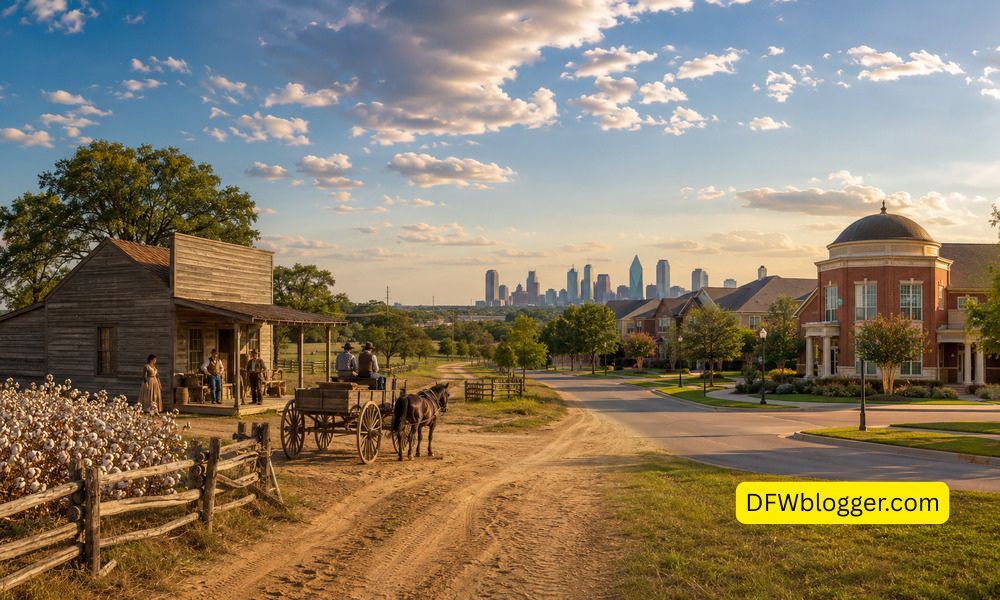
Travel was difficult during those years. Roads were little more than dirt trails used by horses, wagons and cattle. One trail connected Dallas with communities to the south, while another ran between Lancaster and Cedar Hill.
The two trails crossed near what is now the intersection of Hampton Road and Belt Line Road.
Around 1848, T. J. Johnson arrived from Tennessee and opened a small general merchandise store near the crossroads. The store sold supplies to local farm families and became a gathering place for the surrounding community. Before the area received an official name, residents sometimes simply called it “The Store.”
How DeSoto Received Its Name
A post office was established in the community in 1881. According to the City of DeSoto, residents named the settlement in honor of Dr. Thomas Hernando DeSoto Stewart, a respected physician who had devoted himself to caring for people in the area.
The community remained small. By 1885, DeSoto had approximately 120 residents, a general store and a cotton gin. Farming was the center of daily life, with cotton and other crops supporting local families.
DeSoto did not grow steadily during its early years. Its population reportedly fell to only 41 people by 1890. The post office eventually closed in 1906, but the community survived. Families continued farming the land, operating small businesses and building the foundation of the future city.
In 1930, DeSoto had a population of only 97 and seven businesses. It was still a quiet farming community where most residents knew one another.
DeSoto Becomes a City
The end of World War II marked an important turning point. Dallas County began growing, and families increasingly moved into communities outside the City of Dallas.
DeSoto’s residents needed better public services, especially an improved water system. Incorporating as an official city would allow the community to create a municipal government and address those needs.
On February 17, 1949, a petition signed by 42 eligible voters was presented to Dallas County Judge W. L. Sterrett. The petition requested an election to decide whether DeSoto should incorporate.
The election was conducted on March 2, 1949. Fifty residents voted in favor of incorporation, while only two voted against it. The results were entered into Dallas County records the following day, officially creating the City of DeSoto.
Wayne A. Chowning was elected as the first mayor on March 15. The first City Council meeting was held two days later at a schoolhouse on East Belt Line Road. At the time, city officials estimated DeSoto’s population at approximately 400. It became the nineteenth organized municipality in Dallas County. City of DeSoto history
Rapid Growth After World War II
Once incorporated, DeSoto began changing quickly. The 1950 census counted 298 residents and eight businesses. By 1960, the population had increased to 1,969.
The growth of Dallas played an important role. DeSoto offered families room to build homes while remaining close enough to commute to jobs in Dallas, Grand Prairie and other parts of the Metroplex.
For those who remember DeSoto during the 1960s, it still felt like a small town. DFWBlogger’s John Fite lived there and attended school in DeSoto from 1965 through 1971. He remembers a community of roughly 5,000 people—a place where the schools were smaller, open land was common and residents frequently recognized one another around town.
By the official 1970 census, DeSoto had reached 6,617 residents and had 71 businesses. In only 20 years, it had grown from a tiny incorporated community into a developing suburb.
New Roads, Homes and City Services
Growth continued throughout the 1970s. DeSoto improved its roads, parks, water system and sewer infrastructure. Residential subdivisions replaced many former farms and open fields. Commercial and industrial construction also increased.
In 1974, residents of Woodland Hills, a small community northwest of DeSoto, voted on a proposed merger with the city. The decision was remarkably close: 221 votes supported joining DeSoto, while 219 opposed it. Woodland Hills, with approximately 366 residents, became part of DeSoto.
By 1980, the city’s population had climbed to 15,538. DeSoto also had 168 businesses, increasing to approximately 360 businesses by 1984.
The city passed the 30,000-resident mark around 1990 and reached 37,646 in 2000. Its location near Interstate 35E, Interstate 20 and U.S. Highway 67 helped make DeSoto attractive to residents and businesses.
The Town Center and a New Community Identity
One of DeSoto’s most important redevelopment projects was the creation of the Town Center at Hampton Road and Pleasant Run Road. An aging shopping center was transformed into a civic gathering place containing City Hall, the public library, recreation facilities, meeting spaces, an auditorium and an outdoor amphitheater.
The Town Center gave DeSoto something that many growing suburbs lacked: a recognizable civic center where people could conduct city business, attend community programs and gather for public events.
DeSoto also developed a strong identity as a diverse, predominantly middle-class community. Its schools, churches, neighborhoods, civic organizations and local businesses helped preserve a sense of community even as the population increased.
DeSoto Today—and Tomorrow
The 2020 census counted 56,145 DeSoto residents. A 2026 city planning report estimates that the population reached approximately 58,271 in 2025. Regional projections indicate that DeSoto could grow to around 69,000 residents by 2050. City of DeSoto planning report
That is an extraordinary transformation for a community that had fewer than 100 residents in 1930.
Modern DeSoto covers more than 21 square miles and is an important part of the Best Southwest region of Dallas County. Although many of its farms and wagon trails have disappeared, their history remains beneath today’s streets, homes and businesses.
DeSoto’s story reflects the larger history of North Texas: pioneer settlement, agriculture, postwar suburban growth and eventual inclusion in one of America’s largest metropolitan areas.
From a small store beside two dusty wagon trails to a thriving city of more than 58,000 people, DeSoto has traveled a remarkable distance—and its history is still being written.