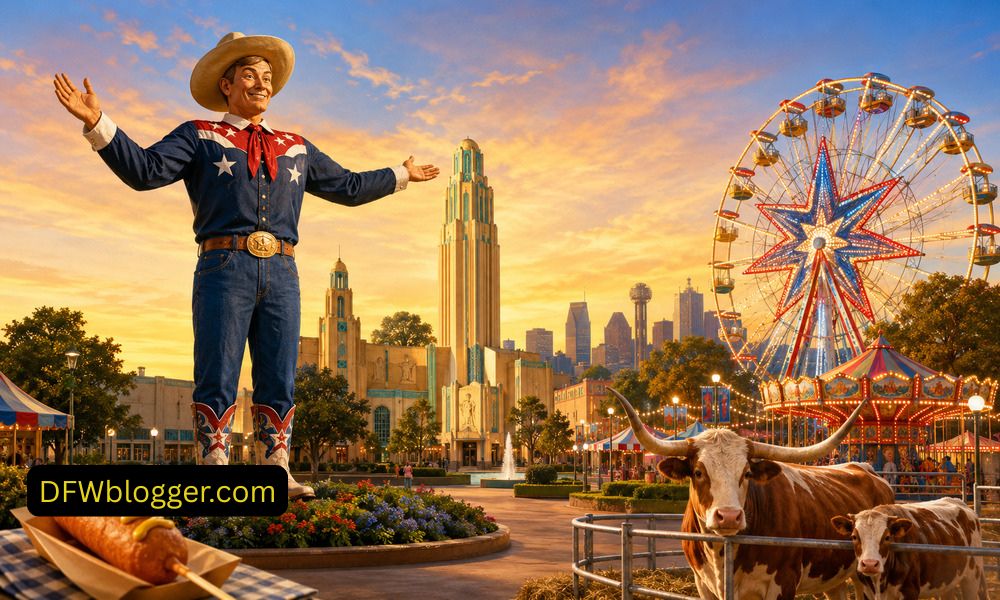
Every fall, millions of visitors enter Fair Park looking for familiar Texas traditions: corny dogs, football, livestock, midway rides and, of course, a friendly greeting from Big Tex.
But the State Fair of Texas existed long before Big Tex raised his hand and said, “Howdy, folks!” Its story stretches back to the nineteenth century, when Dallas was still working to establish itself as an important center of Texas business and commerce.
In a special episode of the DFWBlogger podcast, we explore the complete history of the State Fair of Texas—from its earliest days through the creation of Fair Park, the arrival of Big Tex and the traditions families continue to enjoy today.
It All Started in 1886
The Dallas State Fair Association was chartered in January 1886. Organizers selected approximately 80 acres of cotton fields east of Dallas for the new fairgrounds.
The first Dallas State Fair opened on October 26, 1886, and attracted more than 14,000 visitors. Early fairgoers came to see livestock, agricultural exhibits, machinery, horse racing and entertainment.
For farmers and ranchers, the fair was more than a day of fun. It was an opportunity to compare animals, crops, equipment and new farming methods. Manufacturers demonstrated inventions, while merchants introduced visitors to products that might not yet have reached their hometowns.
The fair was entertaining Texans while also showing them what the future might look like.
The early years included financial problems, fires and other setbacks, but the event continued to grow. The grounds eventually became a destination for activities throughout the year instead of being used only during the fall.
The Transformation of Fair Park
One of the most important moments in Fair Park history arrived in 1936, when Dallas hosted the Texas Centennial Exposition.
The enormous celebration marked 100 years since the founding of the Republic of Texas. Fair Park was redesigned with exhibition halls, fountains, sculptures, murals and impressive Art Deco architecture.
Many of those buildings still surround State Fair visitors today. The Hall of State, the Esplanade and the other historic structures give Fair Park an appearance unlike an ordinary carnival ground.
When you visit the State Fair, the buildings are part of the attraction. They preserve the look and ambition of the 1936 Texas Centennial and help make Fair Park one of Dallas’ most important historic landmarks.
The full DFWBlogger podcast episode takes listeners deeper into the Centennial Exposition and explains how it permanently changed the fairgrounds.
Football at the Fair
Football became another major part of the State Fair experience.
The University of Texas and the University of Oklahoma began playing their annual neutral-site game at the fair in 1929. The rivalry continues to divide the Cotton Bowl into two seas of color—burnt orange on one side and crimson on the other.
The Cotton Bowl has also hosted professional football, major concerts, international soccer and many other historic events. Even with all those uses, its strongest connection may still be the roar of football fans during the State Fair.
Big Tex Was Originally Santa Claus
Big Tex has one of the most unusual origin stories in Dallas history.
In 1949, merchants in Kerens, Texas, constructed a giant Santa Claus to encourage local Christmas shopping. Fair officials later purchased the figure and brought it to Dallas.
The beard and Santa suit were removed, and artist Jack Bridges transformed the giant figure into a cowboy. Big Tex made his State Fair debut in 1952 and soon became the fair’s official greeter and most recognizable symbol.
In 2012, an electrical fire destroyed the original Big Tex. A new and slightly taller version returned in time for the 2013 fair, once again greeting visitors from his familiar location in Fair Park.
The complete Big Tex story—including his unusual construction, enormous clothing and return after the fire—is featured in the DFWBlogger podcast episode.
The Food Became Famous
No history of the State Fair would be complete without mentioning the food.
Fletcher’s corny dogs became a fair tradition after their introduction in 1942. Over the years, turkey legs, funnel cakes, roasted corn, cotton candy and increasingly creative fried foods joined the menu.
Today, new food creations receive almost as much attention as the rides and entertainment. Fair vendors compete for honors in the Big Tex Choice Awards, regularly proving that nearly anything can be battered, fried and served with a pile of napkins.
Some creations become instant classics. Others are remembered mainly because somebody was brave enough to try them.
Agriculture Is Still at the Heart of the Fair
Beneath the midway lights and food stands, the State Fair continues the agricultural mission that helped launch it in 1886.
Young Texans spend months raising and preparing animals for livestock competitions. Agricultural exhibits teach visitors about animals, crops and the work required to produce the food and materials people use every day.
The fair also supports youth through livestock auctions, educational programs and scholarships. These programs remind visitors that the State Fair is more than entertainment—it remains an important showcase for Texas agriculture and young people.
Hear the Complete Story
The State Fair of Texas has survived fires, wars, financial struggles, social change and even the 2020 pandemic cancellation. It continues because it finds ways to change while preserving the traditions generations of Texans love.
There is much more to the story than we could include in one article.
To hear how cotton fields became Fair Park, how the 1936 Texas Centennial transformed Dallas, how Big Tex rose from the remains of a giant Santa Claus and how food, football and agriculture created a Texas institution, listen to “The Complete History of the State Fair of Texas” on the DFWBlogger podcast.
Visit DFWBlogger.com for the full episode and more stories about the history, people and places of Dallas–Fort Worth.